The Book of :
The Hidden Chamber
ca. 1426 BCE
or :
the Twelve Hours of the
Night
and
the Midnight Mystery
Section 3
The Summary of the Amduat
The Twelve Hours : A Commentary
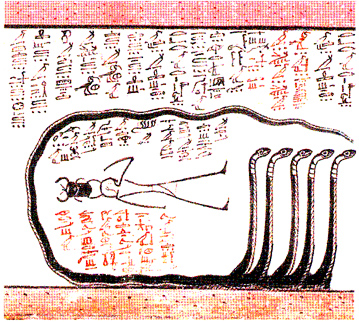
Book of the Hidden Chamber - Sixth
Hour
The five-headed serpent "Tail-in-Mouth" :
"the mysterious image of the Duat, unknown and unseen"
Tomb of Pharaoh Tuthmosis III (ca. 1479 - 1426 BCE)
by Wim van den
Dungen
Section 1
History of the Midnight Mystery
Section 2
Pataphysics of Creation
Introduction
The Summary of the Amduat
The Twelve
Hours : A Commentary
Epilogue
Introduction
§ 1
In Ancient Egypt,
rejuvenation (regeneration) is
Osirian
and Lunar, whereas illumination (rekindling) is
Solar and linked with
the Sungod Re-Atum, the
self-created, fugal, interstitial, sole creator. Floating in Nun, bisexual
Re-Atum engenders him(her)self.
Lunar magic was dark and bound to the netherworld or Duat, and
therefore fundamentally rooted in
Nun,
the everlasting ground of existence. It involved the purification of the
Ka and
the offerings made to it to gratify the
Ba.
Its spirits abided in the sky of Osiris, the Field of Reeds.
Solar magic was luminous. Souls were transformed into spirits ascending towards the sky
of Re, the Field of Peace (Field of Offering). There, in companionship with Re,
they abided for ever on his "boat of millions". Indeed, in the Eastern horizon,
the Ba (or soul), empowered by the Ka (or vital energy), was transformed into an
Akh (or spirit), an efficient spiritual power. These ideas are already embryonic in the
Pyramid
Texts of Unas, the last king of the Vth Dynasty.
In the Old Kingdom (ca. 2670 - 2205 BCE),
divine kingship was already
an institution. Moreover, the
magical role and presence of the "Akh" or efficient spirit of the
divine king was
deemed crucial. After the fall of the Old Kingdom, this attitude changed.
In the Middle Kingdom, the divine role of the "Lord of the Two Lands" was
acknowledged, but the gods & goddesses had gained in importance. If the divine king
died, the deities "took over" and state affairs could continue to count on
popular approval and support. Festivals to honour the deities, thank them for
their help and solicit them again abound. New theological speculations
soon standard. Not only the divine king had a "Ba", as it
had been in
the Pyramid Age, but everybody. Tensions between
Osiris and Re were mediated by identifying the former as the "Re of the Night",
the dark Sun.
Commoners could hope to become spirits in the retinue of Osiris and stay, as
him, bound
to his Duat. This was much better than utter desolation and final annihilation.
Royals and the elite could however ascend to the sky of Re, the place he made for
himself (cf.
The Book of the Heavenly Cow, ca. 1323 BCE). Regeneration & ascension are
the Two Ways of Egyptian spirituality.
Hand in hand with this change of attitude, the role of protective
magic became also more important. Along with personal conscience, afterlife
retribution turned fashionable. Did burial near the king suffice ? Clearly not. To act as
skillful means to control the guardians of the many gates of the Duat, sacred
texts (words of light) were inscribed in and on the coffins themselves. The
process of mummification was enlarged and more amulets and talismans were added
to the mummy, as well as spells on papyrus. Mummification involved the transformation
of the physical body into a mummy. The latter is a ritual object (or "sah"),
magically focusing the attention of the Ka &
the Ba escaping, at death, from the physical net. The mummy is the interphase
par excellence for the transitions & subsequent communication between the
world of the living and the world of the dead.
To avoid
annihilation because of a "heavy heart", pushing the Balance of Truth away
from the Feather of Maat, special spells were added and amulets were
placed on the mummy. "Evil" could be purged by affirming, using sacred language,
one had not done so-and-so (cf. the Declaration of Innocence, chapter 125 of the
Book of the Dead). Beside magical power, initiate knowledge was also
important. The deceased is questioned about names, certain topics and secret
names of gates etc. The proto-causal link, between knowing these names and
overturning whatever opposition presented itself in the afterlife, is implicit.
A magic consisting of graded initiate knowledge & co-relative practices seems to
be the commanding idea here. Both during life, while dying & shortly after death
and in the afterlife, funerary concerns prevailed. In the
Ptolemaic Period, this
magical knowledge (involving astrology, magic & alchemy), is the "technical"
side of the otherwise "philosophical"
Hermetica. It also turned
up in the Western Tradition (the Orientale Lumen, Knight Templars, Qabalah,
Rosicrucianism, Illuminati, Freemasonry, Golden Dawn, OTO, New Age, etc.).
In the Egyptian mysteries, contrary to
Greek initiation, initiate knowledge involved
regeneration & ascension, combining the two two-tiered spiritual economy
developed in the
five schools of Ancient Egyptian theology : Ptah of Memphis (creative mind), Osiris of Abydos
(creative flesh), Re-Atum
of Heliopolis (creative energy), Thoth of Hermopolis (creative word & writing) &
Amun-Re of Thebes (creative kingship) :
-
IN MEDIO LUNA
: the (lower) sky
of Osiris : Field of Reeds : the ultimate state of common human blessedness is to live
the life of an "Osiris NN" in the vast, silent darkness of the Duat.
Eternal sameness, "djet" or "djedet", represented by a goddess, is
associated with the
Lunar Osiris, because (a) his nocturnal
jurisdiction is separated from the diurnal cycle of Re, (b) in the
depths of the Duat, the everlasting waters of
Nun flow and (c) Osiris exists in continuous darkness (he
never leaves the Duat). This is the path of all commoners, doomed
to remain the everlasting slaves of Osiris ;
-
IN TERMINIS SOLIS : the (upper)
sky of Re : Field of Peace : the sky of Osiris and the sky of Re are proximate
but ontologically separate (as darkness is always separated from
clarity). After the highest spirituality of human servitude has been fulfilled
in the kingdom of Osiris, the human "Ba" of the deceased is transformed,
in the horizon, into a divine "Akh" of Re, sailing, among the other pure
beings of light, on the Bark of Re, illuminating day and night. This
path of Re is eternal, cyclical and discontinuous, for light and
darkness are recurrent. This cycle of birth (in the East), full power
(in the South), death (in the
West) and rebirth at midnight (in the North), is
represented by the god Neheh. This is the path of the divine king, his
family and the spiritual elite (the high priests, senior priests and
those specially selected by the divine king).
The New Kingdom "Books of the Netherworld" were the nec plus ultra of
initiate knowledge, kept secret by a very small priestly elite. Because of their
ultimate magical efficiency, realized by integrating new insights into the Duat,
they were written around the sarcophagus of the divine kings. New avenues to a
correct & efficient integration of Lunar & Solar energies (regeneration &
ascension) had been found. As of old, regeneration (burial-chamber) remained the
necessary prelude to ascension (antechamber). The separate jurisdiction given to
Osiris made the Duat-voyage inevitable ! But who, besides the Wailers, wants to
stay with Osiris ? Gods & blessed (justified) humans escape the Duat. Peace is
companionship with Re, being on his bark or in his retinue. To be with this
"great god" is the main soteriological purpose of the Amduat.
When
these Books were edited, the Pyramid Texts, Coffin Texts and early
versions of the Book of the Dead had already been widely used. Since the
Book of the Two Ways (Coffin Texts, Spells 1029 to 1185 - before
ca. 1759 BCE), the priesthood had been doing their more systematic study of the
afterlife, aided by trance, ritual & magic. The tradition of these "Books of the Afterlife" is
the result of this study. An interesting one, pointing to neurotheology,
depth-psychology and spiritual practice. Although we cannot know for
sure what this "research" precisely involved, and despite the fact the
text we have today is only vaguely comprehensible -meaning all of this work is
speculative- we may be sure the Egyptians were very
serious about it.
More than a millennium before these
texts, the
physical tomb and its spatial semantics was canonized (cf. the Pyramid Age).
King Unas (ca. 2378 - 2348 BCE), due to interiorization and maturation, was
first to let the magic of hieroglyphs take over.
Their precise, delicate, colorful and artistic rendering in the dark,
underground chambers of his tomb points to the importance of form. De opere
operato, these beautiful glyphs would execute their allotted tasks. In
pre-rational thought, working with pre-concepts, psychomorphism
endows the object with subjective features. In the Middle Kingdom (ca. 1938 -
1759 BCE) the canon of Imhotep became "classical" and Egypt realized, again as a
nation, a fundamental mental "closure" by establishing a proto-rational system
of concrete concepts. The impact of this "Egyptian Classicism" can be measured
by the continuous reaffirmation of national unity under divine kingship, ending
in the expulsion of the Hyksos and the founding of the "Age of Empire". The New Kingdom (ca.
1539 -
1075 BCE) made this proto-rationality widespread & popular, perfecting the
completion. How hieroglyphs were executed, or their physical endurance were less
the matter, but contents was. Emphasis lay on the actual instantaneous merging of
"textual" & "visual" layers. This was needed to actually comprehend the hours and their
interrelatedness in the process of Solar regeneration (1th - 6th Hour) & Solar
ascension (7th - 12th Hour). This knowledge had proven to be valid and
efficient, "a million times".
The Books of the Underworld are a "strip-like" literary genre, telling
the story of the regeneration of the subtle bodies and the illumination of consciousness, represented by the "Ba of Re" in
his barque. Of
these, the Amduat is exemplar. The important novelty they share is the
"fusion" of Osirian and Heliopolitan material : at dusk (West), the
principle of movement (Ba) of the old Re is exhausted and needs to be
replenished by merging with the body of Osiris in the Duat. The Ba of Re is "swallowed" by
Nut, the star-goddess who's body appears at Sunset. The "unseen" path of Re is
associated with the Duat, the "underworld", starting at 6 pm and ending at 6 am.
To renew, the "Ba of Re", the dynamic principle of consciousness, travels in
darkness. During this Midnight Mystery
(at 12 pm), Re moves to the "first moment", the "zep tepy".
In this first occurrence, Atum
emerges out of
Nun. From there, Re-Atum returns with increased strength, emerging -out
of the vulva of the sky-goddess Nut- as the new Solar child of dawn (cf.
Harpocrates). Passing
through the hours as a Ba-soul, the principle of Solar dynamism seeks
rejuvenation by seeing & fusing with the "corpse of Osiris", merging with the first
occurrence of creation and returning regenerated by it.
|
Nun |
uncreated
not creating |
precreation |
everlastingness :
djedet |
Atum
& Ennead |
uncreated
creating |
eternal First Time :
neheh |
Re
Heru
& Nesu |
created
not creating |
creation |
phenomenal time :
at |
Atum
& Osiris |
uncreated
(not)
creating |
postcreation |
eschatological time |
In the Books of the Underworld, the interpenetration of
the Lunar & Solar ways is
complete. The Ba of Re enters the Osirian Duat to regenerate. Seeing the corpse
of Osiris and assuming the death posture triggers an instantaneous return of Re to the "first time" of Atum
beyond the Duat. Regenerated (rekindled), Re-Atum continues his netherworldly path
victorious, renewed and in total balance (with two Eyes). In the East, he rises
out of Nut's vulva as the Renewed Solar Child (Harpocrates, a form of Horus).
The mummy of Osiris is the Duat, from which new life (Horus) is born (cf. the
scarab or sacred beetle, the end of regeneration, at the end of the 12th Hour).
In this way, the Solar and the Lunar merge in Horus, the divine king. Indeed, Re
and Osiris become the two faces of a single deity.
"This is Re who comes to rest in Osiris. This
is Osiris who comes to rest in Re."
tomb of Queen Nefertari
The Midnight
Mystery itself is the singular "Solar" moment when this Ba is regenerated by
entering the mummy of Osiris and, transcending the Lunar order, reuniting with
the endless ocean before creation began. Seeing what he is not (namely Osiris), Re comes to his true nature.
"The voice of Re is it, which comes to the image
that is in him."
Amduat - 6th Hour, second register
In the Old Kingdom, when the divine king thrones center stage and he alone had a
"Ba" to ascend, he did so to escape Osiris and be with Re. The popular
"dark" Osiris
was at odds with the royal "luminous" Re. Nevertheless, by the time Unas decreed his inner
tomb to be inscribed, Osiris had entered the royal ritual. In it, the divine
king had first to be rejuvenated by Osiris (in the burial-chamber) before
ascending to Re "in the horizon" (in the antechamber), becoming an Akh rising
towards the Imperishable, Circumpolar Stars. The Amduat depicts the ongoing process
of life, consisting of a continuous circular movement of rise, culmination,
dusk, regeneration and ascension (rebirth).
In these New Kingdom manuals, the regeneration of Re happened at midnight, his
ascension at dawn. The
hidden and mysterious image of the Duat, the mummified corpse of Osiris, invoked
the everlasting presence of the pre-existing, everlasting ocean of Nun, the infinite,
thick darkness in which Atum lay dormant, and out of which the world-order
emerged. This thick darkness is the primordial, passive matrix
out of which bi-sexual Atum, by his own effort, awoke. The Midnight Mystery
involves, by seeing & entering the mummy of Osiris (assuming the death posture), a secret merging of Re with his pre-creational origin. By
seeing everlasting darkness, one jumps to one's true nature, and so consciousness is fully replenished.
§ 2
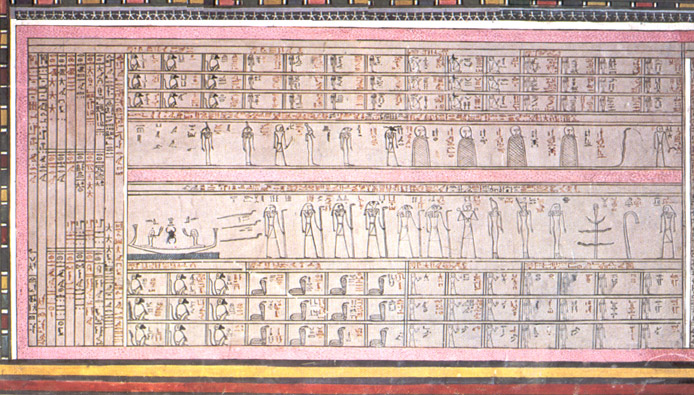
First Hour - note the absence of
the Solar Bark in the upper middle register
sarcophagus chamber of the tomb of
Pharaoh Amenhotep II - ca. 1400 BCE.
The long title of the Book of the Hidden Chamber begins with : "writings of the hidden chamber".
This is the first
completely illustrated book in recorded history, for visual elements, like sequences of
drawings and textual material form a
solid unity. The book is divided in 12 Hours along the nocturnal arc of the Sun,
from dusk till dawn. Each hour,
except the first, has a horizontal heading summarizing its significant events,
use and direction. A vertical introduction, dividing the hours, mentions the
names of the hour, their gateways and areas of the Duat. Only the first three hours
have concluding texts. Retrograde writing is preferred, and representations are
mostly to be read in reverse. Each hour is divided in three registers. The
middle one depicts the Solar Bark, center stage in the storyline. The upper and
lower registers represent the left & right banks of the netherworldly Nile. At
times the registers interlace. All these changes are part of the sacred geometry
and its spatial semantics directly influencing, as in a strip, the intended
meanings.
In addition to the long version of the text, a short
version or summary is found in the tombs and on papyri, called by
Maspero (1893) and
Jéquier (1894) "abridged", from "sehuy", "summary". In it, important names
on the individual hours are listed and further remarks on their usefulness. It
contains no pictures and is appended to the book as a kind of concluding
chapter.
This summary is translated here.
Hieroglyphs and other English
translations can be found in
Budge (1996) and
Hornung & Abt (2007). In the former, the hieroglyphs from the
tomb of Seti I and those from the Leiden Papyrus (T.71) are given. In the
latter, a collated version is found, based on all available hieroglyphs, as
given in :
Hornung, E. : Das Amduat : Die Schrift des Verborgenen Raumes,
Harrassowitz - Wiesbaden, 1963.
Hornung, E. : Texte zum Amduat, Egyptica Helvetica / Editions de
Belles-lettres - Geneva, 1987 - 1994.
The present translation made use of all these sources. The numbers given in the quotes refer to
Hornung & Abt (2007).
Hermeneutically, the most detailed egyptological analysis of the hours can be
found in : Hornung, E. : Die Nachtfahrt der Sonne. Eine altägyptische
Beschreibung des Jenseits, Artemis & Winkler - Zürich, 1998. An English
summary is available in :
Hornung, E. & Abt, Th. : Knowledge of the Afterlife, Living Human
Heritage Foundation - Zürich, 2003.
Schweizer, A. : The Sungod's Journey through the Netherworld, Cornell
University Press - London, 2010.
When the New Kingdom ended, the book, no longer a royal privilege, was copied on
papyrus and used by Theban priests and their relatives. It
remained well known up to the end of the Pharaonic Period, and was quoted in
Roman papyri. In the late exemplars, the contents of the book (text and figures)
remained unchanged, though on several late sarcophagi, doors guarded by serpents were added. These copies are often more reliable than those of the Ramesside Era.
The occurrence of the Amduat in the royal tombs of the
New Kingdom is as follows :
-
made no use of it : Akhenaten,
Horemheb, Ramesses I ;
-
complete directional versions :
Tuthmosis III (with split registers) and vizier Useramun (with distributional changes)
;
-
complete sequential versions :
Amenhotep II, Amenhotep III ;
-
burial-chamber versions : Tuthmosis
III, Useramun, Amenhotep II & III ;
-
partial versions :
Tuthmosis IV, Seti I (no 12th), Tutankhamon, Merneptah -
Ramesses III (4th & 5th), Ramesses VI (no 12th) ;
-
excerpts : Ramesses IV -
Ramesses IX.
From a historical and hermeneutical point of view, all
available New Kingdom versions down to Ramesses IX (Hornung,
1987 - 1994) have to be taken into consideration,
although the only complete and directional version of Tuthmosis III
(also the oldest extant) provides the iconographical "main frame".
Regarding the latter,
Hornung
& Abt (2003)
provide color pictures of the 12 Hours found in the tomb of this king. Textually
however,
the version found in the tomb of Amenhotep II is to be preferred.
The interiors of the tombs of Tuthmosis III as well as the other Pharaohs
using
the Book of the Hidden Chamber have been mapped by the excellent "Theban
Mapping Project". A special
image
search is possible allowing one to compare the various versions.
Iconographical standard : the version of Tuthmosis III ;
Textual standards : the text of Amenhotep II compared with all other New Kingdom
versions (cf. collated hieroglyphs as published in
Hornung & Abt, 2007).
§ 3
Form has a distinct purpose : to
facilitate the transitions of meaning. The central theme of the Books of the
Duat is the renewal of Re by regeneration & ascension. The framework of the Amduat
presents this theme in a highly organized way. In no other book, the Book of
Gates excepted, does the fusion between the Ba or soul of Re and the corpse
or mummy of
Osiris dominate all text/image structures. In the Book of Gates, meaning
is infused with the role of the divine king. In the Amduat, hours, registers &
scenes explain and depict a series of operations, in which the deities and the
deceased are differentials in the process of the Midnight Mystery. The
host of deities & justified ancestors (deified humans) are personifications,
metaphors, transformations or faces of the "nature" of Nature, and this in the
form of image/text distinctions sprang out of human nature (Wheeler,
2002, p.21).
The naturalistic approach of the
New Solar Theology (symbolized by
the course of Re) contrasts with the mystical inclinations of
Amenism and its
theology of divine will and personal piety. It links with the Heliopolitan
theology of the Old Kingdom, except for the latter's relational
(constellational) view on the
differentials of nature (each deity also having own-form) and its focus on the
divine king instead of Re. Here, the faces of Nature serve the purpose of the
sole and unique creator-god, Re, of which they are theophanies. The ultimate mystery
(or secret) happened only once a day,
namely in the 6th Hour of the night, while dawn was the expected outcome.
The subdivisions of deities and ancestors aim to refine the
process of renewal, and so all textual & visual elements of the "hidden chamber"
become equations or conceptualized coordinations of movement, as it
were practical referential concepts. When lined up, they depict the grand ritual
of renewal, the formal
gestures of divine ritualists, performing the central ritual of the Osirian-Heliopolitan
faith : outside creation lies a superabundant sea of possibilities but
life-inimical forces (Nun), hiding the capacity to self-create (Atum), and
therewith the potential to renew, rekindle, replenish and rejuvenate the living order.
Osiris can not give this, but he creates the conditions (the mysterious image of
the Duat) to get there (cf. Re assuming the death posture). To
harvest this tremendous power, Osiris had to be "seen", for his endurance is
everlasting. Indeed so powerful was this encounter, that even Re, who merges
with Osiris, is rekindled ...
Osiris never leaves the Duat, and even endures after the destruction of creation !
"He who sees the dead Osiris will never die."
Coffin Texts,
Spell 1050.
§ 4
In the other Books of the Duat, the themes of the
nocturnal journey of the Sun and his mysterious renewal are also
present, but the process is not detailed.
BOOK OF GATES
Hornung (1999) gives as date of origin the
Amarna Period. Pharaohs Horemheb and Ramesses I placed it in their sarcophagus
chamber. The earliest complete and continuous version is on the alabaster
sarcophagus of Pharaoh Seti I. Ramesside Egyptians considered spells 144 & 145
of the Book of the Dead as a non-royal substitute for the Book of
Gates. The title is not attested and in no other book are the gates of the
Duat so systematic and manifest as here. Each gate has one guardian-serpent and
two menacing guardians with fire-spitting Uraei.
Netherworldly gates are found
as early as the Pyramid Texts (in the Pyramid of Khufu, the two shafts in
the Ka-chamber, used in the ascent of Pharaoh to the sky, are sealed with doors
bearing copper handles). They are attributed to Osiris and represent the
knowledge necessary to resurrect and be reborn. Without the proper knowledge,
access was impossible. In the Heliocentric Amduat,
the gates are removed because the natural cycle of Re is all-important, not the
protective magic involved (the many
references to Pharaoh in the Book of Gates underlines its rather Osirian
inspiration). Here, the magical keys are crucial.
The nocturnal journey of the Sun is divided in 12 gates ("sebekhet"), depicted
at the end of each hour. In the Solar Bark, only Sia ("understanding") and Heka
("magical power") accompany Re. The cabin of Re is always surrounded by the
Mehen-serpent, and four figures tow the barque. The judgment hall of Osiris is
depicted in the fifth gateway, immediately before the union between the Ba of Re
and the mummy of Osiris, the recurrent theme and emblematic of the Midnight
Mystery. By letting him accompany Re to his rebirth at dawn, the special status of Pharaoh is underlined.
BOOK OF CAVERNS
The earliest, nearly complete (but today destroyed) version appeared in the
upper register of the Osireon of Pharaoh Seti I, and occupied the left wall of
the entrance corridor, opposing the Book of Gates. It was not often used,
and the only almost complete exemplar adorns the tomb of Ramesses VI, again
displayed opposite the latter.
The original title is lost. There is no division
into the regions of the night. A division in two halves with a subdivision in
three section is likely. The Solar Bark is absent and replaced by the Solar
Disk, absent in the first two sections. Scenes of damnation and punishment are
reserved for the lower register.
The crucial theme of the first half of the book, is the encounter of Re with
the mummy of Osiris "in its coffer". In the third section, Re enters the "cavern
where Aker is".
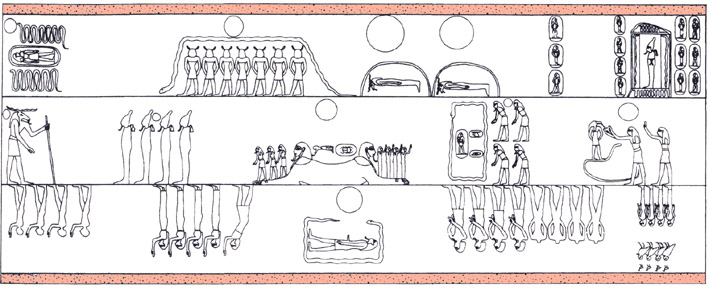
Book of Caverns - third section -
drawing by A.G.Shedid.
BOOK OF THE EARTH
This title was chosen by
Hornung (1999).
Piankoff had "The Creation of the Sun Disk", and Altenmüller "Book of Aker". The
original title is missing. There is no division into the hours and the Solar
Barque is largely absent. The division in registers is uncertain. The book is
exclusively found in the sarcophagus chambers of royal Ramesside tombs.
Osiris "in his coffer" again plays the leading role, as does the transformation of Re
and an expanded version of the eleventh scene of the Book of Gates and
its "barque of the Earth".
BOOK OF THE NIGHT
The earliest version is found on the ceiling of the sarcophagus chamber of
Pharaoh Seti I, but it only reaches the ninth hour. Only the tomb of Ramesses VI
provides us with two complete versions. It is divided in 12 sections separated
from one another by vertical lines called "gates", which precede the hours to
which they belong.
In the Solar Barque, Re is surrounded by the Mehen-serpent
and the crew consists of Sia at the prow, Hu at the stern and Maat.
Descriptive texts are lacking, and the registers are not divided into scenes.
The crucial motif of the union of Re and Osiris is absent.
§ 5
In the Old Kingdom, only the divine king was reborn (Osiris,
burial-chamber and serdab) and illuminated (Re, antechamber and corridor). In
the Middle Kingdom, everybody had a principle of deification (a Ba turning Akh
in the afterlife). Commoners headed to Osiris, the royals with their retinue to Re. As in the Old
Kingdom, Osiris was a necessary condition but not sufficient, albeit only for
the elite. They wanted to ascend to Re's Field of Peace. The vast majority could dream of
the
Field of Reeds of Osiris. In the New Kingdom, Re was being transformed and the king
accompanied. Here, his role had become secondary. The survival of the creator-god
primary. These important changes happened within the stable boundaries of the
two-fold Ancient Egyptian model of salvation mentioned above, inviting the complementarity of a two-tiered
heaven :
-
VIA THE
MOON : the (lower) sky of Osiris : the ultimate state of human
blessedness is to live the life of an "Osiris NN", with a court,
humbling servants and a kingdom situated in the vast darkness of the
Duat (like creation is a bubble of moist air suspended in chaos). Even
the smallest offer made with a sincere heart during earthly life might
be enough to be helped by Isis or Osiris, and so the commoners made sure
the holy family would notice them. This economy is inclusive of
everyman, but conditional, except for the divine king. Corresponds with
the Left,
Restored Eye of Horus ;
-
ENDING IN THE SUN : the (upper)
sky of Re : the
sky of Osiris and the sky of Re are proximate, and after the highest
spirituality of servitude has been fulfilled, the "Ba" of the deceased is
transformed, in the horizon, into an "Akh" of Re, sailing, among the other pure beings of
light, on the Bark of Re or in his retinue, illuminating the beings of day and night,
including the deities and the justified blessed dead of Osiris (who
otherwise sleep). The sacred knowledge regarding this spiritual
evolution was for the very few and, when first written down (cf. the
Pyramid Texts and the
Amduat), portrayed in the tomb of kings
only. This economy is exclusive of everyman, reserved to the deities (as
the king and his high priests) and unconditional. It corresponds with
the Right Eye of Re.
The scattering revolution of Akhenaten (ca. 1353 - 1336
BCE), stressing the
solitary, singular
Aten and denying Osiris and the "hidden" Amun,
heralded the beginning of historical "Egyptian-styled" monotheism. Short-lived in
Egyptian culture, but soon turning subcultural, it triggered the heroic return of
the constellational pantheon, with Amun-Re (consciousness),
Thoth
(mind) and
Ptah (body) working as a divine trinity
(preluding Christian Trinitarism of Father, Son & Holy Ghost). The
Ancient Egyptian elite was
henotheists and remained so. God is "hidden, one &
millions". Each divine face (god or goddess) is a divine manifestation or
theophany of
Amun-Re.
He is all, before all (preexistent) and beyond all (transcending). His essence is truly hidden. Although of
multiple manifestations, he always remains himself. Unlike the singular, sole
monotheist Atenite Godhead, henotheist Divinity or Amenism is a pluralism-under-unity, a
pluritheism unlike polytheism. The latter looses the notion of the
interrelatedness of the epiphanies, i.e. the essential oneness maintained by
henotheism.
|
Treatise
of the Hidden Chamber,
the positions of the Ba-souls,
the gods,
the shadows,
the Akh-spirits,
and what is done.
The beginning is the horn of the West,
the gate of the western horizon,
the end is thick darkness,
the gate of the western horizon,
to know the Ba-souls of the Duat,
to know what is done,
to know their spiritualization for Re,
to know the secret Ba-souls,
to know what is in the hours and their gods,
to know what he calls to them,
to know the gates
and the ways upon which
the great god passes,
to know the courses of the hours
and their gods,
to know the flourishing and the annihilated.
Long
Title of the
Amduat
|
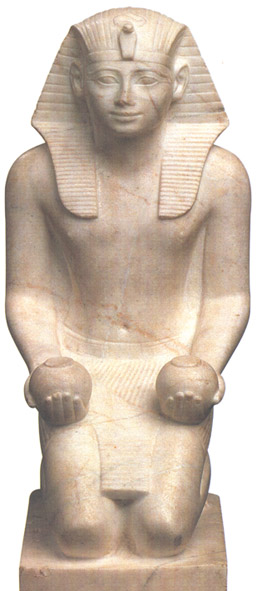
King Tuthmosis III
ca. 1479 -
1426 BCE.
Deir El-Medina - Cairo Museum
|
The Summary
of the Amduat
Summary of this book.
"The beginning is the horn of the West ;
the end thick darkness."
First Hour
This god enters into the Earth,
through the gateway of the western horizon.
It is 120 cubits to journey over this gateway,
before he reaches the gods of the Duat.
"Waters of Re" is the name of the first realm of the Duat,
where he assigns fields to the gods following him.
He begins to give orders,
and to take care of those of the Duat in this field.
It is executed like this original,
in the secrecy of the Duat.
He who knows these images is like the great god himself.
It is beneficial to him on Earth ; a true remedy.
It is beneficial to him in the Duat, immensely.
"Smashing the foreheads of the enemies of Re"
is the name of the first hour goddess of the night,
who guides this great god in this gateway.
Second Hour
Setting afterwards by this great god in Wernes.
309 cubits is the length of this region,
120 cubits (its) breadth.
"Ba-souls of the Duat" is the name of the gods who are in this region.
As for him who knows their names, he will be among them.
This great god will assign him fields,
at their place from the region of Wernes.
He will pause together with the pausing one (Re),
and he will process behind this great god.
He will enter the Earth and he will open the Duat,
he will cut off the locks of the "Braided ones".
He will pass by the "Donkey-swallowers" behind the Maat of the plot.
Always will he eat bread in the bark of the Earth,
and will be given the prow-rope of the Sun bark.
These Ba-souls of the Duat are done in painting,
in their forms in the secrecy of the Duat,
the beginning of the writing towards the West.
Offerings are made to them on Earth in their names.
It is beneficial to a man on Earth,
a true remedy, (proven) millions of times.
He who knows these words which the gods of the Duat speak to this god,
and the words this god speaks to them,
is one who will approach to those of the Duat.
It is beneficial to him on Earth,
a true remedy, (proven) millions of times !
The name of this hour of the night
who guides this god in this region is :
"The wise who protects her master".
Third Hour
Setting afterwards by the Majesty of this great god
in the fields of the
shore-dwellers,
rowing by this god on the water of Osiris.
309 cubits is the length of this field, 120 the breadth.
This great god gives orders
to those who follow Osiris at this place.
He assigns plots to them at this field.
"Mysterious Ba-souls" is the name of the gods who are in this field.
He who knows their names on Earth,
will approach the place where Osiris is.
Water will be given to him at this his field.
"Water of the Unique Master, which brings forth offerings" is the name of this
field.
These secret images of the mysterious Ba-souls have been made in this form,
which is painted in the secrecy of the Duat,
the beginning of the writing to the West.
It is beneficial to a man on Earth,
and in the necropolis ; a true remedy.
He who knows them, will pass by them,
he cannot perish from their roaring,
and cannot fall into their pits.
Whoever knows them, belongs to the places,
his offering cake at (his) face, together with Re.
Whoever knows them is an efficient Ba-soul,
master over his two feet,
who will not enter the place of destruction.
He will always go forth with his forms,
as one who breathes air at his hour.
The name of the hour who guides this great god in this field is :
"She who cuts Ba-souls".
Fourth Hour
Pausing afterwards in being towed by the Majesty of this great god
in the mysterious cavern of the West.
Caring for those who are in it with his voice,
without him seeing them.
The name of this cavern is : "With living forms".
The name of the gate of this cavern is : "Which hides the towing".
Whoever knows this image of the mysterious ways of Rosetau,
the unapproachable paths of the Imhet,
the hidden gates which are in the land of Sokar-upon-his-sand,
is one who will eat bread besides the living in the temple of Atum.
Whoever knows it is one with just paths,
going on the ways of Rosetau,
and seeing the images of the Imhet.
The name of the hour of the night guiding this great god is :
"She who is great in her power".
Fifth Hour
This great god is towed on the paths of Maat of the Duat,
through the upper half of the mysterious cavern of Sokar-upon-his-sand.
Unseen and unperceived is this mysterious image
of the land which bears the flesh of this god.
The gods among whom this god is, they hear the voice of Re
when he calls to the region of this god.
The name of the gate of this place is : "Station of the gods".
The name of the cavern of this god is : "West".
The mysterious ways of the West,
the gates of the Hidden Chamber,
the unapproachable place of the land of Sokar :
flesh, members and body in (their) first manifestation !
The name of the gods who are in this cavern is :
"Ba-souls who are in the Duat".
Their shapes are that which is in their hours,
their mysterious shapes.
Unknown, unseen,
and unperceived is this image of Horus himself.
This is done like this image
which is painted in the secrecy of the Duat,
on the southern side of the Hidden Chamber.
Whoever knows it, this Ba-soul will be content,
and he will be content with the offerings of Sokar.
The "Violent one" cannot cut his corpse,
he will pass her in peace.
Offerings are made to these gods on Earth.
The name of the hour of the night,
who guides this great god in this cavern is :
"She who guides in the midst of her bark".
Sixth Hour
Setting by the Majesty of this great god
into the depths of the waterhole of those of the Duat.
He gives orders to the gods who are in it,
he orders that they take hold of their divine offerings at
this place.
He proceeds in this, equipped with his bark,
he assigns to them their plots for their offerings.
He gives to them water from their waterway,
when passing the Duat, day after day.
The name of the gate of this place is : "With sharp knives".
The mysterious path of the West,
whose water this great god traverses in his bark,
to care for those of the Duat.
Registered in their names,
known in their bodies and carved in their forms are the hours,
mysterious in (their) state,
without this secret image of the Duat being known by any person.
This image is painted in this way,
in the secrecy of the Duat,
on the southern side of the Hidden Chamber.
Whoever knows it will belong to the offerings in the Duat,
he will be satisfied with the offerings of the gods following Osiris,
offerings will be given to him and his family in the Earth.
Orders are given by the person of this god,
to present divine offerings to the gods of the Duat.
When he pauses by them, they see him,
and take possession of their fields.
Their offerings, they emerge by order of this great god.
"The depths, waterhole of those of the Duat" is the name of this field.
It is the path of the bark of Re.
The name of the hour of the night
guiding this great god in this region is : "Arrival that gives the right (way)".
Seventh Hour
Resting by the Majesty of this great god in the cavern of Osiris.
Giving orders by the Majesty of this (great) god
at this cavern to these gods who are in it.
This god takes another form at this cavern,
he confounds Apopis from the way,
through the magic of Isis and the Eldest Magician.
The name of the gate of this place
which this god passes by, "Gate of Osiris" is its name.
The name of this place is : "Mysterious cavern".
The secret path of the West,
upon which this great god passes in his unapproachable bark.
He proceeds on this way,
which is without water, and without the possibility of towing.
He sails by the magic of Isis and the Eldest Magician,
and by the magic power on the mouth of this god himself.
The slaughtering of Apopis is done in the Duat at this cavern,
his place however is in the sky.
It is painted in this way,
on the northern side of the Hidden Chamber in the Duat.
It is beneficial for whom it is made,
in heaven and in Earth.
Whoever knows it is one of the Ba-souls with Re.
Executed are these magic spells of Isis and the Eldest Magician,
which they perform as a repelling of Apopis from Re in the West.
It is done in the secrecy of the Duat,
and it is done on Earth likewise.
Whoever knows it will be in the bark of Re,
in heaven and in Earth.
It is simple to know this image,
but who does not know it cannot repel "Horrible of Face".
As for this sandbank of "Horrible of Face" in the Duat :
it is 450 cubits in its length,
and he fills it with his coils.
His slaughter is made against him,
without this god passing by him,
when he makes his way around him at the cavern of Osiris.
This god passes along in this place,
in the image of the Mehen-serpent.
Whoever knows it on Earth, "Horrible of Face" cannot drink his water.
The Ba-soul of him who knows it cannot perish,
through the violence of the gods who are in this cavern.
Whoever know it will be one whose Ba-soul the crocodile will not swallow.
The name of the hour of the night,
guiding this great god in this cavern is :
"She who repels the Evil One and slaughters 'Horrible of Face'".
Eighth Hour
Resting by the Majesty of this great god,
at the caverns of the mysterious gods who are upon their sand.
He gives order to them from his bark to his gods who tow him,
in the protecting embrace of the Mehen-serpent.
The name of the gate of this place is : "Standing without getting tired".
The name of this place is : "Sarcophagus of her gods".
The mysterious caverns of the West,
which the great god passes in his bark,
being towed by his gods who are in the Duat.
This is done like this image which is painted,
on the northern side of the Hidden Chamber in the Duat.
Whoever knows them by their names,
will have clothing in the Earth,
and will not be repelled from the mysterious gates.
He will be fed at the great tomb ; a true remedy.
The name of the hour of the night guiding this great god is :
"Mistress of the deep night".
Ninth Hour
Resting by the Majesty of this great god in this cavern.
He gives orders from his bark to the gods who are in it.
The crew of the bark of this great god (also) rests at this place.
The name of the gate of this place,
through which this great god passes,
that he sets upon the waterway, which is in this place, is :
"Guardian of the flood".
The name of this place is : "With images flowing forth".
The mysterious cavern of the West,
where this great god and his crew rest in the Duat.
These are done with their names,
like this image which is painted
on the eastern side of the Hidden Chamber of the Duat.
Whoever knows their names on Earth,
and knows their thrones in the West,
will occupy his throne in the Duat,
standing among the "Lords of Provision",
and declared "justified" by the tribunal on the day of judgement.
It is beneficial to whoever knows it on Earth.
The name of the hour of the night
guiding this great god in this cavern is :
"She who adores and protects her Lord".
Tenth Hour
Resting by the Majesty of this great god in this cavern.
He gives orders to the gods who are in it.
The name of the gate of this place through which this great god passes is :
"With great manifestations, giving birth to forms".
The name of this place is : "With deep water and high banks".
The mysterious cavern of the West,
at which Khepri rests with Re,
at which gods, Akh-spirits and the dead lament
because of the mysterious image of the Beyond.
This is done like this image which is painted,
on the eastern side of the Hidden Chamber of the Duat.
Whoever knows them by name,
traverses the Duat right to the end,
without being repelled from "The lights of the sky" with Re.
The name of the hour of the night
guiding this great god to the mysterious paths of this place is :
"The furious, who slaughters him with crooked heart".
Eleventh Hour
Resting by the Majesty of this great god in this cavern.
He gives order to the gods who are in it.
The name of the gate of this place,
through which this great god passes is :
"Resting place of those of the Duat".
The name of this place is : "Mouth of the cavern which examines the corpses".
The mysterious cavern of the Duat,
through which this great god passes,
to come out from the eastern mountain of heaven.
Time swallows her images
in front of the seer who is in this place.
She gives them (back) afterwards
for the birth of Khepri in the Earth.
This is done in this form,
like this image which is painted,
in the secrecy of the Duat,
on the eastern side of the Hidden Chamber.
Whoever knows it, participates in offerings as a well-provided Akh-spirit,
in heaven and in Earth ; a true remedy.
The name of the hour of the night
guiding this great god in this cavern is :
"Starry, Lady of the Bark, who repels the enemy when he appears".
Twelfth Hour
Resting by the Majesty of this great god in this cavern
"End of the thick darkness".
This great god is born in his manifestation of Khepri at this cavern.
Nut and Naunet, Hehu and Hehut, emerge at this cavern
at the birth of this great god,
that he comes out from the Duat.
He places himself in the day-bark,
and appears from the thighs of Nut.
The name of the gate of this place is :
"That which raises the gods".
The name of this place is : "With emerging darkness and appearing births".
The mysterious cavern of the Duat,
at which this great god is born,
that he comes out from the Nun,
and that he sets at the body of Nut.
This is done like this image which is painted,
on the eastern side of the Hidden Chamber of the Duat.
It is beneficial for whoever knows it
on Earth, in heaven and in the Earth.
Closing Text
The beginning is light,
the end thick darkness.
The course of Re in the West,
the secret plans which this god brings forth in it,
the excellent guide, the secret writing of the Duat,
which is not known by any person, save a few.
This image is done like this,
in the secrecy of the Duat,
unseen and unperceived.
Whoever knows this mysterious image will be a well-provided Akh-spirit.
Always will he leave and enter again the Duat,
and speak to the living.
A true remedy, (proven) a million times ! |
The Twelve Hours
: A Commentary
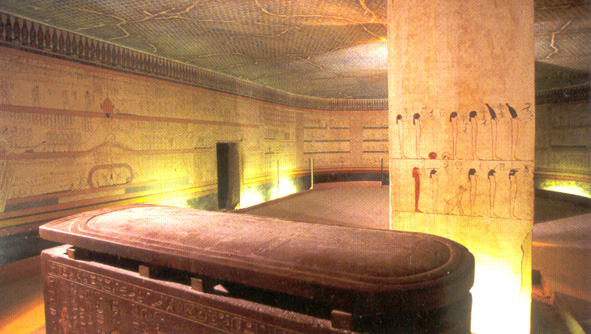
Burial chamber of
the tomb of Pharaoh Tuthmosis III - ca. 1426 BCE.
On the walls, the Twelve Hours of the Book of the Hidden Chamber.
"Thus, the journey of the Sungod can also be seen as
a symbolic representation of an inner psychic process of transformation
and renewal." -
Hornung & Abt,
2003, p.9.
Insofar as the "Ba of Re" is the effective, dynamical, motoric power of Re
and Re is identified with the bright clarity of consciousness or
sentience, his night-journey can be reconstructed as the process of
clarification in the absence of light (what Re does in the Duat), of
inner vision (the mummy of Osiris) and regeneration (rekindling) in the utter deep, dark
desolation of the 4th to 6th Hour, of transformation (Khepri) & rejuvenation
(by time-reversal) and of rebirth or reappearance (as Horus the Child on
the Eastern horizon). The stages of this process run parallel with the
three phases identified
earlier as the three stages of the Upper
Paleolithic cave mysteries :
-
"the entry"
: the tunnel
into the mountain :
the process of differentiation from light to darkness : this
corresponds with the First Phase (the West), digging into darkness,
depleting sentient power to its utter limit ;
-
"the sanctum" : the
rock cathedral in which the shamans dance : the secluded place of the mystery of the hidden light
: this corresponds with the Second Phase (the South), and the Midnight
Mystery, involving (a) the mummy of Osiris seen in the desert of Sokar &
(b) the union of the Ba of Re with the corpse of Osiris (Re assuming the
death posture) ;
-
"the return or exit"
: returning to the outside
world transformed : the process of integration
from darkness to light : beginning slowly in the North (7th & 8th
Hour), more momentum is gained in the East (9th to 12th Hour). Transformed
(Khepri) and rejuvenated (Mehen-serpent), consciousness is refreshed to
the point of being like that of a powerful youth, fully aware & radiant.
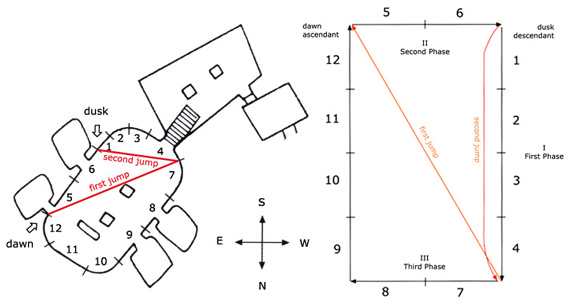
the Hours and their directions in
the burial-chamber of Tuthmosis III
Although in the text the 12 hours are distributed in tune with the
cardinal directions, only Tuthmosis III followed this scheme. Following these
orientations, we arrive at an ideal rectangle, with Hours 1-4 in the West, 5-6
in the South, 7-8 in the North and 9-12 in the East. This rectangle reminds
of the standard form of the Sed-festival court, used in one of the most
important events of a king's reign : the Sed festival.
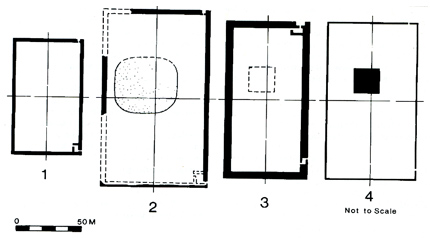
comparison between different
enclosures or Sed-festival courts
Abydos (Djer), Hierakonpolis temple, Abydos (Khasekhemuy), Netjerikhet
The Sed festival was an occasion for renewal
"of kingly potency and the reaffirmation of the divine
descent of the king and thus the confirmation of his right to the throne."
(Serrano,
2002, p.43).
During this festival, the divine king would perform the Sed festival dance, the
running of the ritual course before an assembly of deities. He ran round a track
four times as the ruler of the South and four times as the ruler of the North.
This ritual run proved he was fit to rule the Two Lands. On both East and West
sides of the Sed-festival court were shrines dedicated to provincial deities,
and the throne of the divine king stood on a platform at the southern end of his
own "court of appearance", adjacent to the Sed-festival court (cf. the
Netjerikhet complex).
In the Amduat, as New Kingdom theology demands, Re and no longer the
divine king stands center stage. But his ordeal, namely reversing the depletion
of his power at the end of the day, is identical to the Pharaoh seeking
rejuvenation. Re moves from West (where he sets, eaten by Nut) to East (where he
reappears out of her thighs). Functionally, this half-circle or nocturnal
semiarc is defined as a rectangle, involving two "jumps", one between the 4th &
the 5th Hour (placing the latter beside the 12th Hour), and one between the 6th
& the 7th Hour :
-
transversal jump between the 4th
and 5th Hour : arriving at the deepest, darkest point (the end of
the 4th Hour), attention is brought on the process of regeneration itself
(the 5th & 6th Hour). In the 4th, Re cannot be more powerless, for he
cannot see those he cares for, relying on his voice alone. The actual
process of self-regeneration is initiated in the 5th Hour of the night ;
-
linear jump between the 6th & the
7th : the regenerated Solar Ba "jumps" the sequence of the first
four hours (the western wall), as it were "reversing" them. Re confronts
his enemy in the 7th Hour and can then proceed to finalize his forthcoming
appearance, involving putting on "new clothes", entertaining a renewed
vision and being rejuvenated by time-reversal.
Each jump brings a fundamental change in
direction, meaning & intent. Each is fragile, calling for prudence and involving
great dangers. As both 4th & 5th Hour are emphasized (some passages are in
cryptographic script, the registers partially cross, and the Solar bark, of
serpentine form, is
being towed), we may assume the first jump, involving the transverse crossing of the
sarcophagus room, is the most dangerous of the two. In the 7th Hour, Apophis tries to
destroy what was gained in the 6th Hour, but, thanks to Isis and the Eldest Magician,
namely Seth, fails without ado. In the 5th Hour however, the darkness entered in the
4th Hour makes way for crucial preparations culminating in the 6th Hour, when the
Midnight Mystery of this Ars obscura is at hand.
The captions are arranged in three registers, with the Solar bark, the "barque
of the millions" in the middle.
This representation is suggestive of the river Nile and its two banks crowded
with "shore-dwellers", greeting Re on his bark, blessed by his swift appearance.
The shore-dwellers are the blessed spirits (of Osiris), the pantheon, the
ancestors and the noble dead. While the upper register depicts general phenomena,
the lower introduces motifs specific to the region of the hour. In all cases,
the middle register holds the central theme, involving the Solar boat and its
immediate environment. In the later Book of Gates, the Solar bark is
towed in each of the 12 hours, while here this only happens in the 4th, 5th, 8th
and 12th Hour, events integrated in the momentum of the netherworldly process of
Solar regeneration.
At dusk, the Ram-headed Ba, the inner, executive power of Re, enters the Duat (the word for "ram" -or Ovis longipes
palaeoaegypticus- is also "bA"). The soul of Osiris was
thought to reside in the sacred ram "Ba-neb-djedet", worshipped in the Delta
town of Mendes. Although "old", Re is glorious and triumphant. The good citizens of
the Duat rejoice when they see him (while Re's enemies do not
participate), for seeing Re is being. In each hour, except in the dark 4th Hour, Re
communicates with the deities and blessed deceased. For these glorious dead, one
hour with Re is experienced as a lifetime ... They awaken when they see him and
slumber when he leaves. In this state, they barely exist at all, and are reborn
when Re passes by again.
Phase I : The Entry
the West : The Deepening of Darkness
1.1 The 1th Hour :
In the 1th Hour, Re speak the following words to the gods of the Duat
:
"Open your gates for me !
Open wide your gateways for me !
Illuminate for me what I have made !
Guide me, ye who came forth from my limbs !
Indeed, I commended You to my corpse !
I made You for my Ba-soul.
I created You for my magic power.
I have come that I may greet myself with myself,
that I let my limbs breathe when they rise.
I exterminate him who acts against it.
I cause Osiris, Foremost of the Westerners, to breathe as the secret image.
Baboons, open for me your arms !
Spread wide your gates for me, baboons !"
Amduat, 1th Hour, 151 - 156.
Name of the Hour : "Waters of Re" ;
Name of the goddess :
"Smashing the foreheads of the enemies of Re" ;
Structural features : parallel registers, double middle register,
Grand Chorus, two Solar boats ;
The overall structure of the hour is very balanced. Although Re is "entering the
West", we see how his command is regal. The Double Maat guides Re on the
way of darkness. The beings of the
Duat greet Re with jubilation. Upper and lower registers have identical
subdivisions, suggestive of a Grand Chorus greeting the Sungod.
As a Ba-soul Re enters the night, knowing his way
in the darkness of the night to his rebirth at dawn. During this period, his
continues to care for the beings of the hours and for himself. This cycle of Re
is recurrent. He
does it since the eternal First Time, when Atum self-created. Beneath the boat of
the aged Sungod is the bark of the resurrected Sungod, represented by the
scarab or beetle Khepri, symbolizing the upcoming renewal, adored by two
kneeling figures of Osiris.
Main visual semantic : antechambers of the Duat :
Re at dusk and dawn ;
Because of the largely static Grand Chorus, the main action is given in the
double middle register, suggestive of "begin" (the old Re) and "end" (the
resurrected Re) of the Duat.
Theme : summary of beginning and end of the Hidden Chamber.
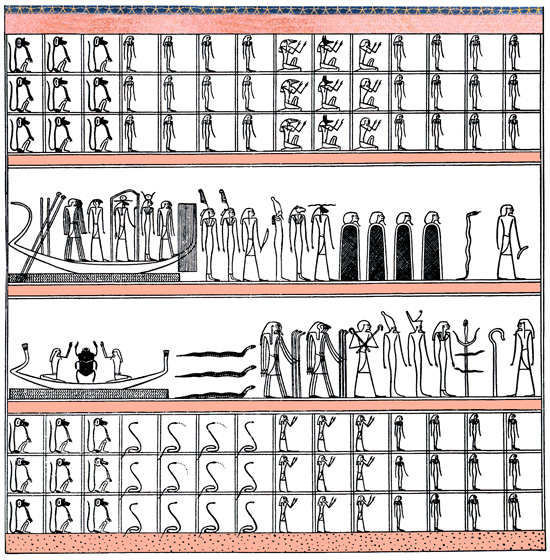
Drawing by A.G. Shedid (digitally
enhanced) -
Hornung (1999).
This first hour is a kind of antechamber of the Duat,
an
interstitial realm or twilight zone between dusk and Re's visual absence,
namely when Re has been totally "eaten" by Nut, displaying her dark,
starlit body. The
journey begins in order to end. The cycle is eternal, its repetition
divine. The beginning alludes to the end, when all is completed.
Beginning and end of the process of transformation are to be considered
together. The "neheh"-time of Atum-Re is not everlastingness, i.e. the
eternal "ground", "base" or "foundation" of everything (Nun, associated
with Osiris and the Duat). "Neheh"-time is the eternal, recurrent cycle of
Atum-Re, with its day (Book of the Day) & night (Book of the
Night, Books of the Duat). At night, Re regenerates.
The 1th Hour
brings out the function of the Duat as a whole, namely regeneration by
conjunction with the First Instance. It also represents a preliminary period before entering the
total darkness of the Duat. Before crossing the border between the
1tht Hour and the Duat proper, a preparative stage is necessary (cf.
twilight and falling asleep). At the First Instance, like Khepri, Atum
self-created. The beetle plays a central role in the process of
regeneration, as it were pointing to the core of the process itself : Atum
autogenitor, i.e. "Atum-kheperer".
By a step-by-step encounter with the beings and processes of the Duat,
consciousness (Re) is renewed. The Solar bark itself represents the concrete
concept enabling one to traverse the unconscious waters (Nun) in which
consciousness is afloat (Atum-potential of Nun or "Ba of Nun"). The Solar
boat
allows consciousness to gather and be self-contained, functioning
properly. Without it, it would drown and be lost in the vast expanse of
the thick darkness of Duat, as it were rooted in everlasting Nun.
1.2 The 2th Hour :
The gods of the Duat speak the following words to Re
:
"O ! Appear, great Ba-soul !
The Duat has received the flesh belonging to heaven.
You are now living, flesh, in the Earth which is protected for You.
Come indeed, Re, that You live in your name (of) "Living One",
Khepri, Foremost of the Duat !
You traverse the fields, protector,
You bind the Hiu-serpent, and You strike "Horrible of Face" !
Joy and jubilation are in the Earth to (You) who uncovers his corpse.
Shine great illuminator ! (...)
Be radiant You (Uraeus-serpent) on the head of Re !
Drive away the darkness in the hidden realm
in your name "He who chases him away with the secret arm".
Illuminate thick darkness, that the flesh may live and be renewed by it !"
Amduat, 2th Hour, 218 - 230.
Name of the gods : "Ba-souls of the Duat" ;
Name of the goddess : "The wise who protects
her master" ;
Structural features : Re's flotilla arrives in the Duat, no Solar Disk
;
Instead of a single boat, five boats are depicted. The activity of the
Sungod expands, touching all netherworldly beings. The lower register
pictures the beings ensuring the agricultural year : inundation, sowing
and harvest. Other beings carry ears of corn and they assign plots to land
to the followers of Osiris, the "peasants of Wernes" ;
Main visual semantic : fertile waters carrying the Offering Barks of Re
;
Theme : the power of the Sun activates the Duat.

Drawing by A.G. Shedid (digitally
enhanced) -
Hornung (1999).
The actual netherworldly journey begins with the 2th Hour,
when the actual Duat is entered. Apparently, Re never travels alone, for
his bark is always part of flotilla, carrying provisions and magical
signs. These assist him and show how he Re is well-prepared for the
extraordinary states of consciousness represented by the Sungod entering
darkness and being at work there. It points to a depth-psychological
dimensions avant la lettre, one established by way of
concrete concepts, not abstractions.
Hornung & Abt (2003) were the first to identify the salient
features of this remarkable process invoked by this Ars obscura of
Re.
The bark of the Sungod is headed by Isis & Nephthys, represented by two
serpents, while the Sungod has no longer a Solar disk on his head. He has
entered the darkness ruled by the Moon.
Indeed, in this hour, the light of the
Moon has become visible (cf. the last boat, with a crescent Moon disk
and the feather of Maat). Maat can also be seen at the beginning of the
upper register, indicative of the fact the Duat contains ordering
forces regulating the renewal of the effective power (Ba) of Re.
Moreover, the regeneration of the year (the cycle of the Sun) calls for 12
renewals of the Moon, just as the nightly journey of the Sungod till his
resurrection takes 12 hours. Hence, annual, monthly & daily rhythms are
interlinked.
A flotilla of offerings are seen. Re assigns land to the blessed dead, the
peasants of Wernes, the watery expanse. Many deceased need to be fed
and nurtured by his depleting powers. Despite Re is on a descendant
slope, he nevertheless fulfills his eternal task. They rejoice in what they
receive, namely Re's presence. Because of this, they are kindled.
Without him, they slumber. This metaphor reminds of the state of Osiris
before Horus brought him his renewed Left Eye. He was weary, inactive and
in agony. Although resuscitated (by Isis & Thoth), he was not yet fully
regenerated, transformed or resurrected. Only after receiving
the
Eye of his
son Horus, who, in tune with the
sapiental discourses (of for example
Ptahhotep), therefore becomes more
powerful than his father, does
Osiris become King of the Duat. Indeed, Horus can leave the
Duat (Osiris never does) and becomes King of the Two Lands.
The Sungod pays attention to what happens in the Duat and dialogues with
the fertility-deities. This points to their mutual interdependence.
Consciousness (Re) enters the Duat of darkness & unconsciousness (Osiris).
Although this "other side" is out of reach, but not devoid of energy,
communicating with it offers a complete renewal of one's elements.
1.3 The 3th Hour :
The mysterious gods of the Duat speak to Re
:
"Come to us, You whose flesh is being towed,
and who is guided by his own body,
interpreter of the Duat, Lord of Breath,
whose body speaks, who provides for his life !
Your Ba-soul appears and your power flourished.
Your two Maat-goddesses guide You on the way of darkness.
The sky belongs to your Ba-soul, the Earth to your corpse.
The unique one rises up for You,
alone at the two-rope which the jackals moor.
The arms of the Westerners receive You
in your protected form of 'Old Man'.
How beautiful is it, that the Westerners can see,
how satisfying it is, when those of the Duat can hear Re,
when he sets in the West,
when his light is put into the region of dark images.
Come indeed to us, Re of the horizon,
Gold Khepri, seed of the gods !
You sail by the banks of the Duat,
You traverse your hidden fields,
and You make transformations in that your Earth !"
Amduat, 3th Hour, 313 - 320.
Name of the Hour : "Water of the Unique Master, which brings forth
offerings" ;
Name of the gods : "Mysterious Ba-souls" ;
Name of the goddess of the Hour :
"She who cuts Ba-souls" ;
Structural features : middle register is
still waterway, Re is absent ;
Like in the 2th Hour, the middle register "floats" on the Nile. Here, the
metaphysical root of the fertile waters of the previous hour is addressed,
for the Nile is born in the Duat, hence "Water of the Unique Master", i.e.
Osiris. These deep causes are powerful ("Ba") & mysterious.
Main visual semantic : the "Water of Osiris",
a Solar bark without Re, images of the Sungod, flotilla has mutilated
figures ;
Theme : the fragmentation of Solar power, loss of borders and inertia.
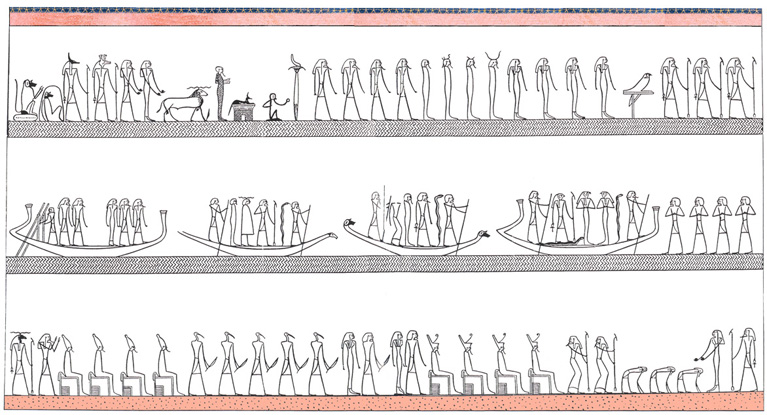
Drawing by A.G. Shedid (digitally
enhanced) -
Hornung (1999).
The flotilla-theme of the second hour is continued,
but extended to the mythical root of the Nile and its inundation, namely
the notion the Nile originated in the Duat, reaching Egypt at Elephantine,
which had Khnum as its chief deity (first deity of lower register). The
lower register continues on this theme, invoking divine kingship (White &
Red Crowns) and Orion (a stellar form of Osiris), connected with the
beginning of the inundation, providing Ancient Egyptian civilizations its
natural source of surplus and power. The upper register reveals the magic
to cause the inundation, for these deities are
"Grinding the enemy and letting Nun come into existence, making the Nile
inundation flow and the storm go forth from the Earth beneath them." (Amduat,
3th Hour, 281 - 283). Indeed, the movement of the
figures in the upper register is unidirectional, nothing being able to
stop the inundation of happening.
There is no single barque of the Sungod. A central figure on the Solar
Bark is missing. Re seems totally absent. The four boats represent four
functional states of Re :
-
a Solar bark without Re :
in the texts, Re is present in all four ships. But he cannot be clearly
identified, each bark revealing part of his functional characteristics.
Here, his centralizing role, made poignant by eliminating the icon of Re
on the Solar bark, is emphasized ;
-
the Ram-headed one
:
dressed in a Sed festival short cloak, this figure points to Osirian
rejuvenation, regeneration etc. Re (light) and Osiris (darkness) are
intimately linked ;
-
the Radiant one without head
:
this mutilation of the central figure underlines the fragmentation of the
unity of the Sungod, while this "baboon" bark may be suggestive of the
role of divine thought ;
-
a Follower of Horus
:
originator of the royal dynasty, Re is the true King of the Two Lands, and
Horus his representative on Earth (the closing "10th" factor completing
the Ennead).
The differentiation
has reached a threshold value beyond which no return to the previous
order is possible. The
creator-god has exhausted himself and needs a procedure to rekindle.
Imminently, a radical change is going to take place. This will unveil the
dreamlike, shape-shifting & time-shifting qualities of Re's experience in
the Duat. At the end of this hour, Re reached an ultimate point of
fragmentation. A reassembly is needed, introducing another "level" of the
Duat. We move away from the familiar scenery of Re's flotilla peacefully
entering the night, greeted by cheerful dwellers blessed by the mere sight
of it. Like in a dream, we break away from the loose, familiar images
emerging when falling asleep, and enter the domain of the dreamworld
proper, which has its own set of "private" laws and conditions,
introducing new degrees of freedom in terms of space & time. In a dream,
changes may happen suddenly and introduce unexpected experiences.
Likewise, in the next hours of the night, new dimensions of the Duat are
entered, and Re faces his own fundamental auto-regenerative move.
1.4 The 4th Hour :
"The one belonging to Rosetau.
Secret paths of Rosetau. The divine gate
He cannot pass them, but it is (only) his voice which they hear.
Path entered by the corpse of Sokar-upon-his-sand.
Secret image which can neither be seen nor beheld.
Secret path entered by Anubis to conceal the corpse of Osiris.
Secret path of the edge of the Imhet."
The Five Texts in the Desert Path,
4th Hour, 352 - 353.
Name of the Cavern : "With living forms" ;
Name of the Gate : "Which hides the towing" ;
Name of the goddess :
"The great one in the Duat" / "She who is great in her power" ;
Structural features : towed snake Bark, knives cutting registers, sarcophagus
;
Main visual semantic : desert of Rosetau, land of Sokar
;
Theme : darkness and silence : the ultimate
isolation of Solar power.
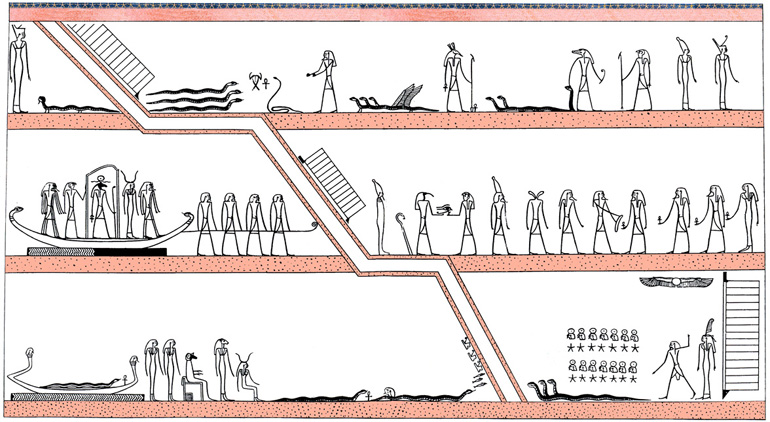
cutting through the registers -
Drawing by A.G. Shedid (digitally
enhanced) -
Hornung (1999).
The 4th Hour begins with an abrupt scene change. The
Solar bark, transformed into a Serpent bark, is on a narrow stretch of water running in a vast desert, the
Earth of Sokar "he upon his sand", the Lord of the mysterious ways of
Rosetau. This desert is populated by gigantic serpent monsters.
The Sungod is back in his bark, as is the Sun disk upon his head (lost in
the 2th Hour). If in the 3th Hour he had been absent from the scene, while
the texts affirmed Re was on all four boats, now his icon is back, but the
texts explain he cannot be seen ! A remarkable juxtaposition.
The scepter in Re's hand has changed. It too has become a serpent,
indicative of his commanding power over the serpent world. To journey this
dark hour, filled with all kinds of serpents, Re needs to control them. The zigzag
"serpentine" path (cf. The Five
Texts in the Desert Path) underpins the awkward motility of the Solar
bark.
The region of Rosetau is linked with death and the god Sokar, a funerary
form of Osiris, linked with mummification, entombment and the mysteries of
the Duat (cf. the sarcophagi moving
downwards). The secret, mysterious, hidden doors etc. remind of
the devices found in the Book of the Two Ways (Coffin Texts, Spells
1029 to 1185). Knowing the proper names guaranteed full protection in the
Duat.
"SPELL FOR THE PATHS OF ROSETAU.
These paths here are in confusion. Every one of them is opposed to its fellow.
It is those who know them who will find their paths. They are high on the flint
walls which are in Rosetau, which is both on water and on land."
Coffin Texts,
Spell 1072.
"(...) I have opened up Rosetau that I may ease the
suffering of Osiris ..."
CT,
Spell 1079.
"This is the sealed thing which is in darkness, with
fire about it, which contains the efflux of Osiris, and it is put in
Rosetau. It has been hidden since it fell from him, and it is what came
down from him on to the desert of sand. It meant that what belonged to him
was put in Rosetau."
CT,
Spell 1080.
In this hour, Re is repeatedly
blocked by doors called "knife", cutting the way into pieces. Re utters
words of power without seeing those he wakes up from their slumber of
near-death, nor can they see him, for he turned into a dark Sun.
In this deepest hour of darkness, Re can no longer see the
inhabitants of the Duat. They hear him, but no one answers Re. Absence of light and silence overpower
his soul.
Because of this thick darkness, his Left Eye has been injured, but it is protected by Thoth and "he
who is upon his sand", Sokar himself, anticipating its healing. The
old myth of the battle between Horus and Seth (with Horus loosing his Left
Eye restored by Thoth) is transposed and placed at the preliminaries of
the process of regeneration. Total darkness and silence (symbolized by
Sokar) and knowledge of the words of power (symbolized by Thoth)
accommodate the process of healing initiated. Renewal & rebirths are
preluded by thick darkness & isolation. In Yoga, during dark retreat,
parallel experiences & processes ensue.
At the end of the 4th Hour, another radical change occurs, for Re has to
make a non-linear jump to enter the 5th Hour. The change of scenery
introduced at the beginning of the 4th Hour acts as preliminary to a more
radical alteration of experienced reality introduced with the 5th. For a
sacred space is at hand, and a radical transition is about to occur.
Phase II : The Sanctum
the South : The Midnight Mystery
The process of Solar regeneration has three subphases :
-
4th Hour : entering Rosetau :
preliminary : sensory deprivation, thick darkness, isolation ;
-
5th Hour : Rosetau proper :
preparation : protected & controlled initiation ;
-
6th Hour : left Rosetau :
completion : the actual process of transformation.
1.5 The 5th Hour :
"This great god is towed along
the proper ways of the Duat,
in the upper half of the secret cavern of Sokar-upon-his-sand.
Invisible and imperceptible is this secret image
of the land which bears the flesh of this god."
Amduat, 5th Hour, 384 - 386.
Name of the Cavern : "West" ;
Name of the Gate : "Station of the god" ;
Name of the gods : "Ba-souls who are in the Duat" ;
Name of the goddess : "She who guides in the midst
of her bark" ;
Structural features : towed snake Bark, Sundisk with Uraeus,
Cavern of
Sokar, sarcophagus ;
Main visual semantic : Cavern, Head, Lake of Fire,
Burial-Mound ;
Theme : preparing for the Midnight Mystery : the protection of the process.
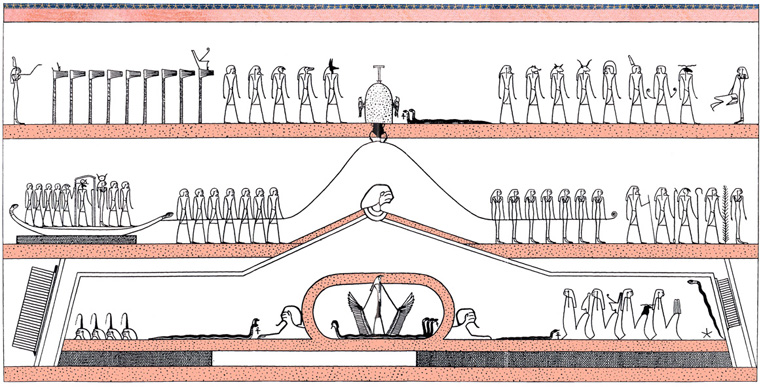
raising up in an oval,
illuminating darkness
Drawing by A.G. Shedid (digitally
enhanced) -
Hornung (1999).
The opposites of fire (desert, Sokar) and water (the
Lake of Fire) meet for the first time. The registers are
not simply parallel (1th - 3th Hour) or cut (as in the 4th Hour), but actually interact
and form one image. The functional components of the Midnight Mystery are
put into place. The "athanor" or alchemical furnace is lit, but the
transformation is not yet happening. After the preliminaries of the 4th Hour, extensive
preparations are now called for. An integration at all levels is needed.
If the zigzag
iconography of the 4th Hour anticipates the transverse "jump" between the 4th & the 5th
Hour, designating the start of a meta-order within the process of Solar
regeneration itself, then the rising of the "mountain" of Osiris from the lower registers
upward may initiate forthcoming integration (from the Lake of Fire & the
Cavern of Sokar in the lower register, to Isis in the middle register and
the burial-mound of Osiris in the upper register). Continuity,
circularity, continuation and interdependence are suggested.
"Secret way of the Imhet on which this god is towed.
It is the abomination of Nehes (Seth).
Gate of the West.
The secret way of the land of Sokar,
which Isis enters on, to be behind her brother.
It is filled with flames of fire from the mouth of Isis.
The gods, the blessed and the dead cannot proceed on it.
The secret way of the land of Sokar and the Westerners who tow this god,
upon which gods, the blessed and the dead do not pass.
It is filled with flames of fire from the mouth of the Wamemty-serpent."
Amduat, 5th Hour, 434 -
438.
In the 5th Hour, the Barque of Re continues its long
journey in the Land of Sokar, suggestive of a period of gestation, i.e.
the inner, dark and silent processing which takes place before renewal.
Painting the 5th Hour on the South wall of the burial chamber, as demanded
by the text, sets it right beside the 12th Hour. In the tomb of Tuthmosis
III, we see how in this way the Solar barque is placed next to Re dawning
in the form of a Khepri-beetle. The end result of the transformation (at
the end of the 12th Hour),
eventuated in the 6th Hour is anticipated (and initiated) in the 5th Hour.
It is the
key to this rekindling.
The upper register starts with a goddess wearing a feather and raising her
arms before the Great Ennead, with Khepri in the place of Atum, and Horus
in the place of Seth. In the tomb of Tuthmosis III, she follows
immediately upon the 12th Hour, and so represents the eternity of
"neheh"-time, the cyclic & recurrent Solar process (Maat is born when
Atum-Re autogenerates), while Osiris, the Duat and Nun indicate
"djedet"-time, the linear, dark (Lunar) everlastingness of precreation. In
the centre, the scarab Khepri (the regeneration of Re proper) emerges out
of the burial-mound of Osiris, surrounded by two wailing birds, Isis &
Nephthys. Guarded by Anubis, this "chest" is called "Darkness", indicating
the functional role of absence of light in the process of regeneration.
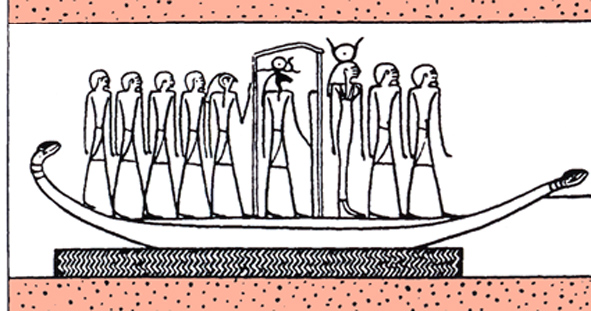
Fifth Hour (middle register,
fragment) - note the
Uraeus-serpent on the brow of Re
Drawing by A.G. Shedid (digitally enhanced) -
Hornung (1999).
In the middle register, the Solar bark, still
serpentine, is being towed
and Re has the Wadjet-serpent or Uraeus on his brow. His knowledge of the
Duat and its mysterious, secret process (represented by serpents) is
complete & protected. The Uraeus spits fire to kill any possible enemy.
In Ancient Egypt, the role of serpents can be
beneficial or afflictive. As serpents love darkness to hide from the Sun,
the Duat is associated with them. Magic is needed to deal with them (cf.
Isis), and
this implies knowledge empowering one's entry into their world.
Assimilating the power of that which one needs to control is the way of the shaman.
Wadjet is
the Single Eye of the supreme, self-created high god of before creation,
namely Atum, turned into a cobra. This Eye is also called the "Eye of Re"
and the "Eye of Horus" (the Elder), associated with the right hand side,
the summer and the Sun. Its mythical activity (like the autocreation of
Atum and the family drama of Osiris) took place in the "First Time", the
so-called "zep tepy" ("zp tpy") or "Urzeit".
|
After having created Shu, space, and Tefnut, moist, Atum was alone in the "zep tepy", or
First Time. Total relaxation surrounded him and this made him "very weary"
(CT, spell 80). So Atum dispatched his Sole Eye (CT,
spell 262) to bring Shu and Tefnut back to him so as to be reunited with
them. The Eye found Shu and Tefnut helpless in
the endless water of Nun. The Eye was able to defend them on their dark,
dangerous journey back to their maker, reuniting the divine with itself. But when
the Eye searched and had fetched what it sought (CT, spell 331), it
became enraged. Atum had put another eye in its place (Bremner
Rhind Papyrus) ! To pacify the jealous Eye, Atum changed it into a rearing
cobra with swollen neck, the Uraeus snake guarding Re's crown, protecting
it and guaranteeing the endurance of his monarchy. So the Uraeus-snake is a
defensive cobra, called "iaret" ("iart" - "she who mounts"),
rearing up to strike with lethal fire-force any enemy of Re or Pharaoh. This
Lower Egyptian cobra-goddess was also called "Wadjet" ("wDt"). |
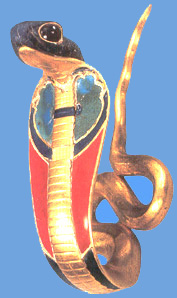
golden uraeus of Wadjet
Senwosret I - XIIth Dynasty
|
The appearance of Wadjet on Re's brow in this hour indicates the complete
readiness of his knowledge and protections. Re is fully equipped to invoke
his own regeneration. The Uraeus complements the serpent scepter of the
4th Hour. It too carries important motifs across the hours, linking them
(1, 2-3, 4-6, 7-8, 9-12). As this image is related with the 12th Hour, the
Wadjet is lost in the 6th Hour, and only regained in the 12th Hour. In the
context of the 5th, it represents anticipated, imminent renewal.
In Re's renewal, three serpents are of note :
the multicolored serpent or Sokar-serpent of the
5th Hour : represents Re as a serpent initiating the process of
transformation by illuminating the Cavern of Sokar by the two eyes of his
three heads ;
Oroboros-serpent of the 6th
Hour : effectuates
the transformation by returning the corpse of Re to the First Time to be
renewed ;
Mehen-serpent
of the 7th Hour :
protects Re in the early stages after this renewal.
The
lower register continues the "secret paths" of the Land of Sokar of the 4th Hour, closed by two
doors. Between them is the interior, or "core" of Sokar's land, with an
"oval", "cavern", "cave" or "egg" in its centre, embedded in the two
halves of the double sphinx Aker, the god of the Earth. Here, the
primordial engine of this process comes into focus, namely the controlled fusion of
Osiris as Sokar and Re as the multicolored serpent in the "Cavern of
Sokar", initiating the transformation.
In the middle register, we see Isis acting as the head over this cavern,
filling it with flames of fire. Defending this threatened area indicates
it is not easily to maintain the conditions necessary for this
transformation to actually happen, hence the long preparations. In this
cavern, Re is represented by a three-headed, winged, multicolored serpent
grasped by the falcon-headed Sokar. A first union is happening, but
remains secret, hidden away. This generates the first spark, which is
completed (actualized) in the 6th Hour. So this hour anticipates the
actual Ars obscura of the 6th and offers the
protective device, a secret "black box", a mysterious cavern or cave necessary to contain the
initiation of the fusion, as well as to maintain the continuous
circulations of energy (within creation and between creation and
precreation) to allowing total transformation.
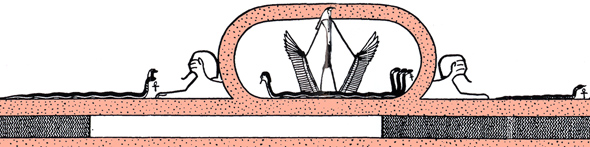
Fifth Hour (lower register,
fragment showing the Sungod as
"the great god who spreads his wings, with multicolored plumes"
Drawing by A.G. Shedid (digitally enhanced) -
Hornung (1999).
"This image is like this in the
thick darkness.
The oval belonging to this god (Sokar) is illuminated
by the two eyes of the heads of the great god (the serpent).
His two feet shine in the coils of the great god,
while he protects his image.
A noise is heard from this oval,
after this great god has passed by them,
like the thundering ground of the sky in a storm."
Amduat, 5th Hour, 443 - 445.
The central theme is the "image" of Sokar in general, and the
"cavern" or "cave" of
Sokar in particular. The latter is embedded in the double head of Aker,
the old god of the Earth in the form of a Sphinx (lower register). The
oval
lies flat on a patch of sand in the middle of an underground structure,
closed by doors, topped by the head of Isis (in the middle register), and
"floating" on the "Lake of Fire", represented by waves (sometimes painted
red). From this Lake of Fire, the blessed drink cool water, but for
sinners it is like fire. Like the Holy Grail, it either regenerates or
destroys. This pyramidal mound is called the "image of
Sokar", and is suggestive of the
Osireon.
Illuminated, like everything in the oval, by the light coming out of the
eyes of the multicolored serpent, Sokar,
falcon-headed, grasps the wings of this life-giving, three-headed serpent,
"the great god who spreads his wings, with
multicolored plumes". Its tail
is a man's head with the beard of a god, and above we read
"he lives from
the breath of his mouth every day".
This winged serpent (the secret flesh) and the "Cavern of Sokar" are
central to the whole 5th Hour, and key to the anticipated rejuvenation.
Apparently, they eyes of the Sokar-serpent spat light (fire), illuminating the
oval.
On the border of the cavern we read : "Land of Sokar.
Aker,
guarding the mysterious flesh." Is this "mysterious flesh" also an "image"
of the body of Osiris, to be entered in the 6th Hour, i.e. the death
posture assumed by the Sungod ?
Underneath the Cavern of Sokar is
Lake of Fire. Its water is red (in some tombs it is painted red & blue).
In normal and cryptic script the text says :
"Water, which the gods mourn in the Imhat
necropolis. The barge does not pass them. The inhabitants of the Duat will
not grasp their water, (which) is in this necropolis, for the water to
those who are in their necropolis is fire."
Amduat, 5th Hour, underneath
the lower register.
This Lake of Fire is a place of fiery punishment for the damned, but the
blessed dead drink cool water from it. This "fire-water" is a powerful
alchemical symbol, related to Philosophical Mercury (Aqua Mercurii).
Dependent on one's attitude and condition, this water changes function.
Constructive (blue) to some, it is destructive (red) to others.
Burning Water implies to gain access to the inner planes of consciousness
and imagination.
And this is precisely what is happening here. The Sungod is about to
regenerate completely and to do so he needs to access the deepest layers
of the Duat, the thick darkness of the sinister Land of Sokar.
1.6 The 6th Hour :
"Pronounced by their names,
known by their bodies,
engraved by their forms,
and their hours, mysterious in their essence,
without this secret image of the Duat being known by any human being.
This image is made in paint like this
in the secrecy of the Duat, on the southern side of the Hidden Chamber.
He who know it will partake of the offerings in the Duat.
He will be satisfied with the offerings to the gods who are in the
following of Osiris.
All he wishes will be offered to him in the Earth."
Amduat, 6th Hour, 460 - 464.
Name of the Hour : "The depths,
waterhole of
those of the Duat" ;
Name of the Cavern : "West" ;
Name of the Gate : "With sharp knives" ;
Name of the goddess : "She who arrives" / "Arrival that gives the
right (way)" ;
Structural features : waterhole of those of the Duat, Tail-in-Mouth
;
Main visual semantic : Re unites with Osiris and receives new Eyes
;
Theme :
rekindling of Solar power thanks
to singularity between Re and Osiris.
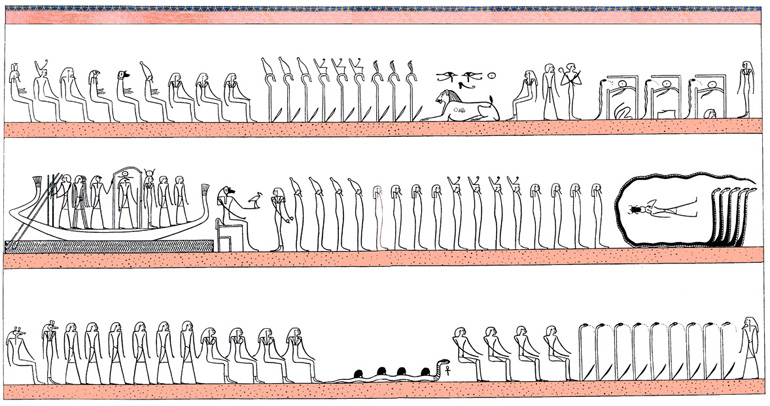
Drawing by A.G. Shedid (digitally
enhanced) -
Hornung (1999).
The 6th Hour is the "waterhole" of those in the Duat, filled with Nun,
the primordial ocean and its regenerative powers, i.e. the presence of a
creative potential (or Ba) within this darkness, namely : Atum. The
Ba-soul of Re assumes the death posture, and "becomes" Osiris as the
corpse of Re. After igniting the alchemical fire in the 5th Hour (in the
Cavern of Sokar erected on the Lake of Fire), the soul of Re moves to the First Time (spiritualizes by
becoming Akh) and returns rekindled.
Nun is the guardian of this hour. As
he did on the first instance, the Sungod is about to emerge out of the
primordial ocean, being, like Atum, the soul of Nun. To realize this, he
must "enter" the mummy of Osiris, assume its death posture (the corpse of
Khepri) to escape the world (of creation, of Kas & Bas) and enter in
spiritual communion, as Akh of Re, with Atum, the autogenitor in
aeternam ("zep tepy").
Each register depicts this union is a different way :
upper register : Re, resting upon his divine
eye, hears the Bull rejoice with roaring voice ;
middle register
: the
baboon-headed Thoth offers an Ibis to a goddess called "Lady with the
Eyes" - Oroboros-serpent
protects & allows
the transformation to effectuate by returning the corpse of Re to the First Time to be
renewed, while the whole of Egypt participates in this (cf. the figures of
Upper & Lower Egypt) ;
lower register
:
the regenerative power of the primordial waters are underlined here (cf.
Sobek and Nun framing the lower register).
In the Midnight Mystery, the midnight Sun returns to its pre-existent, primordial origin, Atum
(autogenitor). In the 6th Hour, the Land
of Sokar is left and the water hole filled with Nun is reached. Here
is the secret image of Osiris, the corpse of Khepri.
In the
mysterious image of the serpent called "Tail-in-Mouth" (representing the concluding phase
of the renewing cycle, the niche of the mysterious fusion and the
hyperdynamics of this singular conjunction), the corpse of Re with a
beetle above its head, may be identified with Osiris. The protective
cavern becomes a protective snake. The process of time is circular,
beginning and end touch. The nature or stuff of consciousness (its "body" and
"flesh") is the mummy of Osiris. The inner power of Re's soul, the
operational side of conscious awareness (its "Ba" or "soul"),
unites with its own everlasting and natural foundation, moves
through the autogenic, extra-cosmic base, and returns
replenished and filled with a surplus of energy able to effectively
add reality to creation, i.e. extend existence. This
union of the body of Osiris with the soul of Re (assuming the death
posture) will continue until the end of the 12th Hour, when Osiris is left
behind in the Duat.
The middle register starts with the words :
"This great god travels in this region on the water.
He rows through this field to the place of the corpse of Osiris. This great god
addresses the gods who are in the fields. He moors at these mysterious
tombs
which contain the image of Osiris. This god calls out above these
mysterious tombs, and it is (his) voice which this god hears. Then he
passes on, after he has called out."
Amduat - 6th Hour, 485 - 488.
This hour is one of great magic. Only now is the bark of the
Sungod arrested by the throne of Thoth, who offers a sacred Ibis (himself) to a
goddess hiding the eyes of the Sungod. The pivotal moment is represented by the Tail-in-Mouth-serpent, called
"Many Faces", and surrounding this five-headed serpent we read :
"This is the body of Khepri as his own flesh. 'Many
Faces' guards him. He is like this : his tail is in his mouth. This is what
he must do : he is stretched out beneath this image (of the body of Khepri).
Then the entire West comes to him without him going to any other
place in the Duat. The voice of Re is what comes to the image which is
in him."
Amduat - 6th Hour, 502 - 504.
The corpse of Re, represented by the reclining figure with a beetle-head,
is an image of Osiris. When the Ba of Re is near total depletion, Re is
"flesh", the "image of Osiris". Like Osiris, Re needs to be
restored. "Many Faces" makes the rejuvenation of Re's soul possible. The
powerful Oroboros-serpent is not only symbolic of eternal ("neheh") time and
the continuity of life, but of the "zep tepy" itself. Moreover, it reveals
its essential mechanism : eternal recurrence, duality-under-unity and the
cyclical nature of all things.
The "mysterious image of the Duat"
depicts the synthesis of Egyptian magic, religion and spirituality in
terms of the economy of Re. The corpse of Re is encircled by the
protective womb of a mysterium coniunctionis between the physical
cycle of Re and the spiritual power of Atum. Hence forward, the light of
Re is rekindled. The body of Khepri encircled by "Many Faces" is also Re's
encounter with himself, which makes him project outside creation and unite
with the First Time and with "Atum-Kheperer".
Phase III : The Return
the North : The Empowering
"This god assumes another form at this cavern.
He turns away from Apopis
through the magic of Isis and the Eldest Magician (Seth).
(...)
He proceeds this way,
which is without water, without towing.
He sails by the magic of Isis and the Elders Magician,
and by the magical power which is in the mouth of the (great) god himself.
The slaughtering of Apopis is done in the Duat at this cavern ;
his place, however, is in the sky."
Amduat, 7th Hour,
524 - 525 / 528 - 529.
1.7 The 7th Hour :
Name of the Hour : "Mysterious cavern" ;
Name of the Gate : "Gate of Osiris" ;
Name of the goddess : "She who repels the gangs of Seth" / "She who
repels the Evil One and slaughters 'Horrible of Face'" ;
Structural features : bark of Re stranded, Re with Mehen-serpent,
Apophis fettered ;
Main visual semantic : confrontation and destruction of enemies, fate & destiny
;
Theme : forces of chaos trying to halt the outcome.
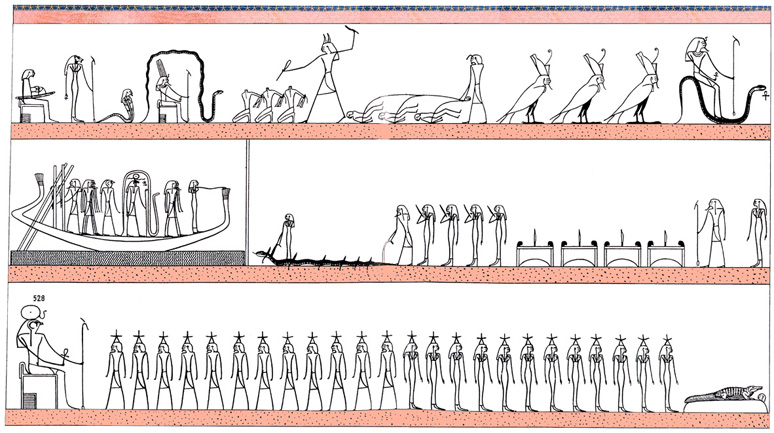
Drawing by A.G. Shedid (digitally
enhanced) -
Hornung (1999).
Integration, starting with the division of Re and Osiris, risks to be
halted in the 7th Hour, for Apopis swallows the water-way. Isis and
Seth cast a spell on him, while Selkis throws fetters around his body.
Re is protected by the Mehen-serpent. No evil can harm him and his
retinue. The period just after the rekindling is a moment of great
danger. The jump from the South wall to the North wall underlines this.
The barque of the Sungod is brought in direct proximity to the end of the
dark 4th Hour. There, due to dark forces, all was also dried up. Here too,
the archfiend of Re and of the cosmos itself has swallowed the water and Re cannot continue !
As soon as the Sungod regenerates, the forces of evil try to destroy him.
Evil is apparently always a little bit too late, for when Re was weak,
Apopis did not appear ! Here, Re is no longer powerless, and it is this
return of power which stirred evil. Apopis thinks he will manage, for Re's
renewed powers are not yet radiant & strong. The course of the Sungod is
halted to repeat the murder of Osiris and stop the regeneration of the
cosmos.
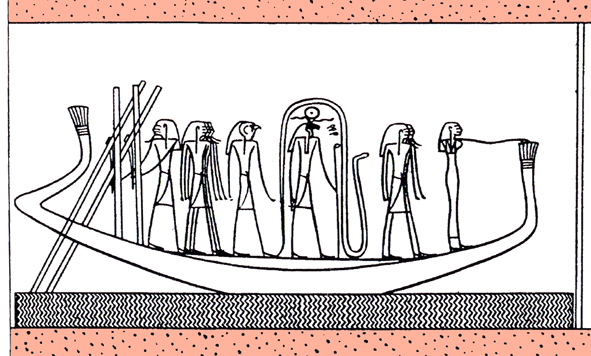
Seventh Hour - Re with
Mehen-serpent - tomb of Tuthmosis III - ca. 1426 BCE.
Drawing by A.G. Shedid (digitally enhanced) -
Hornung (1999).
In vain ! The Sungod is protected by the
Mehen-serpent, the "Enveloper". In the 4th Hour, the serpent was only a
vessel, but now, after what happened in the 6th Hour, it is personally
related to Re. The creation of new light in the abyss of Nun can in fact
not be stopped.
At the prow we see Isis and Seth, the most powerful magical duo of the
Egyptian pantheon. Apparently, due to his regeneration, Re has again
access to magic and its ultimate role : protection.
In the upper register, we see how Osiris too is protected by the
Mehen-serpent. He functions again in his own right, destroying the enemies
of Re, who are decapitated. After their union, Re has in Osiris an active,
supportive ally in the Duat. As Re was renewed by Osiris, Osiris was
renewed by Re. Nocturnal & diurnal consciousness finally complement each
other, indicative of the success of Re's transformation.
1.8 The 8th Hour :
Name of the Hour : "Sarcophagus of her gods"
;
Name of the Gate : "Standing without getting tired" ;
Name of the Goddess of the Hour :
"She of the midnight" / "Mistress of the deep night" ;
Structural features : Ten Vaults, bark of Re is towed, deities clothed
& unidirectional ;
Main visual semantic : Re connects with his own images, renewal of
the deities ;
Theme : Solar power replenishing the deities of the Duat.
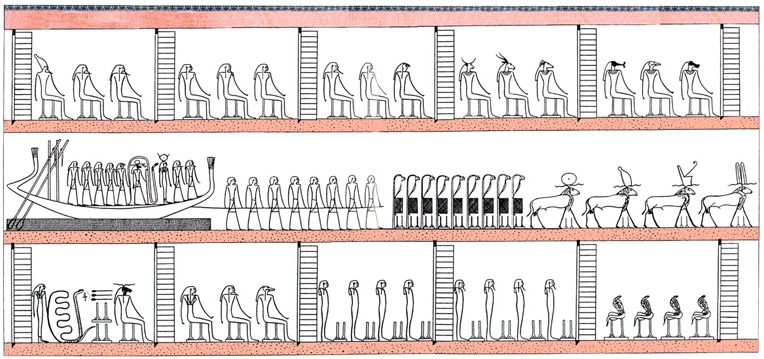
Drawing by A.G. Shedid (digitally
enhanced) -
Hornung (1999).
The 8th Hour sustains the movement of integration.
All deities receive new clothes (receive new doubles), i.e. renew. The power of Re is again
strong enough to sustain everything. The deities died, but are now renewed in
their image (or "ka"). All figures face right, underlining the renewed
dynamics. The boat of the Sungod is towed by eight figures (in the 4th
Hour there were four, in the 12th there will be twelve). The Ten Vaults
are symmetrical and, as in the 1th Hour, bring the returned equilibrium of
the powers of Re to the fore.
In these last hours, Re regains his powers. After the rekindling, a
constant process of integration and development happens. Here, after
the conflict with Apopis, a constant dialogue between Re and the gods of
the Duat is again at hand. The Mehen-serpent is now called
"World-encircler".
Phase IV : The Return
the East : The Rejuvenation
1.9 The 9th Hour :
Name of the Hour : "With images flowing
forth" ;
Name of the Gate : "Guardian of the flood" ;
Name of the goddess : "Protectress of her eye" ;
"She who adores and protects her Lord"" ;
Structural features : unidirectionality, idols offering bread & beer,
spitting serpents, field gods ;
Main visual semantic : deities fed and protecting the flow of the bark of Re ;
Theme :
consolidation of Solar
rejuvenation.
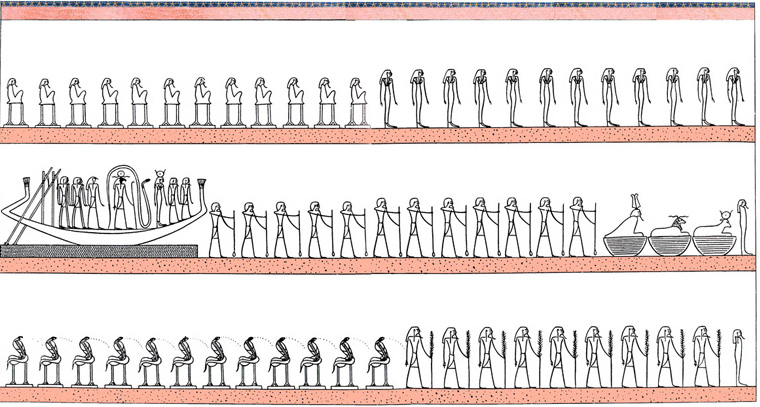
Drawing by A.G. Shedid (digitally
enhanced) -
Hornung (1999).
In the 9th Hour, the forward movement of Re's ascension towards dawn
can no longer be stopped. The renewal of the Sungod is consolidated. In the
upper and lower registers, deities sit on the new clothes they received from Re.
With no hesitation or lingering, Re proceeds. In front of the twelve oarsman
carrying a rudder are idols in charge of the provisioning of the dead with beer
& bread (the gods with the large stalks of grain in the lower register perform
the same function).
1.10 The 10th Hour :
Name of the Hour : "With deep water and high banks"
;
Name of the Gate : "With great manifestations, giving birth to forms" ;
Name of the goddess : "She who rages" ;
Structural features : serpent watcher, renewal of the Eyes, drowned
ones ;
Main visual semantic : restoration of sight of Re, compassion with the drowned
;
Theme : new power giving "new eyes".
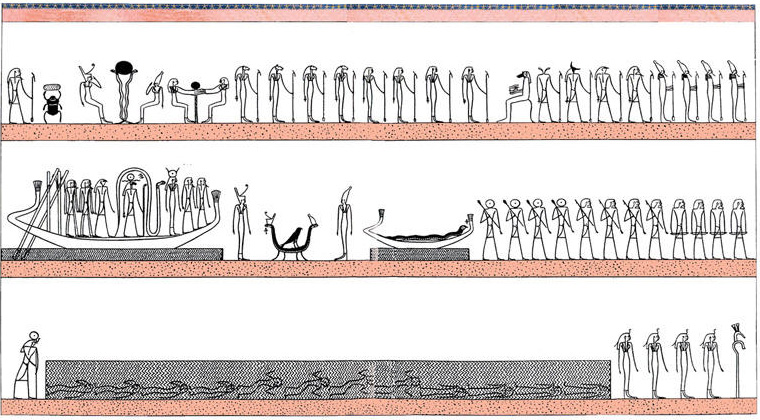
Drawing by A.G. Shedid (digitally
enhanced) -
Hornung (1999).
In this 10th Hour, the restoration of Re's Left &
Right eyes is initiated, but completed in the next. The two eyes are shows
separate and of different size, indicative of the fact the complete healing has
not yet taken place. The Left Eye is born out of a double snake, suggestive of
the myth of the regeneration of Osiris by Horus, travelling into the Duat to
present his restored eye to his father (the
Wedjat).
The Right Eye comes out of the hieroglyph for "god" (nTr). This is followed by
eight forms of Sekhmet, intimately related to the mythology of the Eye of Re
(cf. supra & the
Book of the Heavenly Cow). Re is rejuvenated
and has new eyes (they are nearly cured & protected).
In the middle register, a hawk-headed snake lies in a boat. Twelve defenders
(carrying three different weapons) accompany Re during all hours of both night &
day. In the lower register, the "innocent ones" who died without a regular
burial are rescued by Horus from the "apotheosis by
drowning".
The upper register depicts the scarab "Living beetle"
of regeneration carrying the oval with dots, the image of the Duat and its
process of Solar renewal as a whole.
"They are like this in the Duat as forms and shapes of Khepri when he carries
his oval to this place to go forth afterwards to the eastern horizon of the sky."
Amduat, 10th Hour, 704 - 705.
Indeed, the Cavern of Sokar of the 5th Hour is the conditio sine qua non
of Re's renewal.
1.11 The 11th Hour :
Name of the Hour : "Mouth of the cavern which
examines the corpses" ;
Name of the Gate : "Resting place of those of the Duat" ;
Name of the goddess :
"The starry one" / "Starry, Lady of the Bark, who repels the enemy when he
appears" ;
Structural features : Sundisk with bark, World-encircler, seeing coming out, pits
of death ;
Main visual semantic : completion of healing sight, visions of hell ;
Theme : consolidation of the end of inertia.
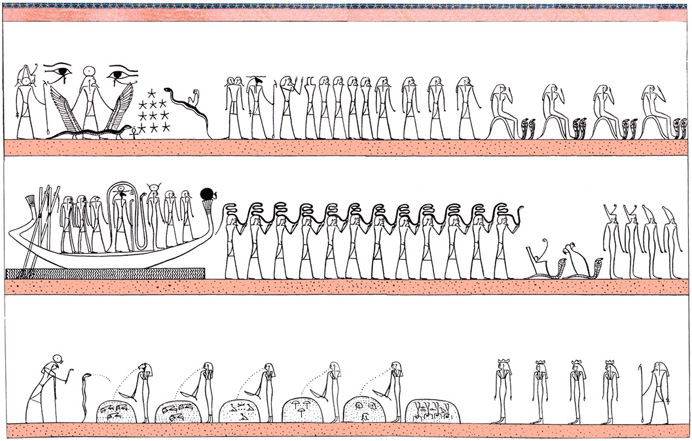
Drawing by A.G. Shedid (digitally
enhanced) -
Hornung (1999).
In this hour, the rejuvenation of Re (his passage through the time-serpent of
the 12th Hour) is anticipated by the mystery of time seen in the upper register.
The Sungod as master of time is represented with the White & Red Crown and a Sun
disk between them, holding a Was and an Ankh scepter.
Here, the double aspect of "eternity" is represented :
Nun
Osiris & Duat |
underlying ground of all |
precreation |
everlastingness :
djedet - Left Eye |
Atum-Re
& Ennead |
creative source of creation |
eternal First Time :
neheh - Right Eye |
The Sungod is the "master of time", and both "flow" ("neheh") and "duration"
("djedet") are addressed. Eternal recurrence or "neheh"-time involves the return
to the First Time of Atum, whereas everlastingness of "djedet"-time points to
the Duat and Osiris, the realm where this renewal takes place, as well as the
fundamental ground of everything : the creative ocean of Nun. The two eyes, with
Atum in the middle, make clear Re's sight is again perfectly balanced.
"Time. He who takes away the hours. Her own body : She is upon 'He who takes
away the hours'. What she has to do : To live through the voice of Re, day after
day. She swallows her images (again) at this place."
Amduat, 11th Hour, 757 & 758 / 753.
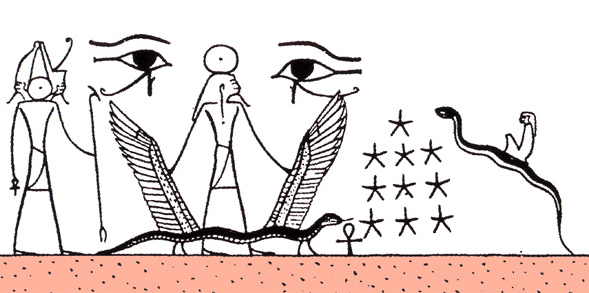
Eleventh Hour - Atum-Re as time
god - tomb of Tuthmosis III - ca. 1426 BCE.
Drawing by A.G. Shedid (digitally enhanced) -
Hornung (1999).
The wings of the serpent called "Seer" are grasped
by Atum, and above the scene are the two Eyes, the left (Lunar) and the right
(Solar), pointing to the full restoration of Solar consciousness in this hour.
The serpent resembles the form of the Sungod in the Cavern of Sokar (5th Hour),
suggesting the process of renewal started then. The ten stars plus the goddess
"time" sitting on a serpent indeed represents the individual hours which have
already elapsed till now.
In the middle register, the bark of the Sun has the Aten or Sun-disk on the
prow, guiding the Sungod. This clearly references the completed renewal of Re. All preparations for the
imminent Sunrise are present. We see how the huge serpent "World-encircler" is carried in
front of the Sun boat. All of this anticipates the final rejuvenation of Re.
To avert any treat to the dawn of Re, punishment is afflicted on the damned. In
the lower register, they are burned in fiery pits. Their destruction is complete
:
"Orders given by the person of this god to slaughter those
who beat his father Osiris, i.e. the corpse of the enemies, the limbs of the
dead, those who are upside down, hindered on going, and the shapes of the
annihilated."
Amduat, 11th Hour, 779 - 781.
1.12 The 12th Hour :
"This great god is born in his manifestations of Khepri at
this cavern. Nun and Naunet, Hehu and Hehut, emerge at this cavern at the birth
of this great god, that he goes forth from the Duat, places himself in the
day-bark, and appears from the thighs of Nut."
Amduat, 12th Hour, 794 - 795.
Name of the Hour : "With emerging darkness and
appearing births" ;
Name of the Cavern : "End of thick darkness" ;
Name of the Gate : "That which raises the gods" ;
Name of the goddess : "She who beholds the
perfection of her Lord" ;
Structural features : Khepri on towed bark,
World-encircler, the "sah" of Osiris ;
Main visual semantic : reversal of time, birth of new Sun, praise of the Sun
;
Theme : full Solar power emerging : radiance, sight and presence.
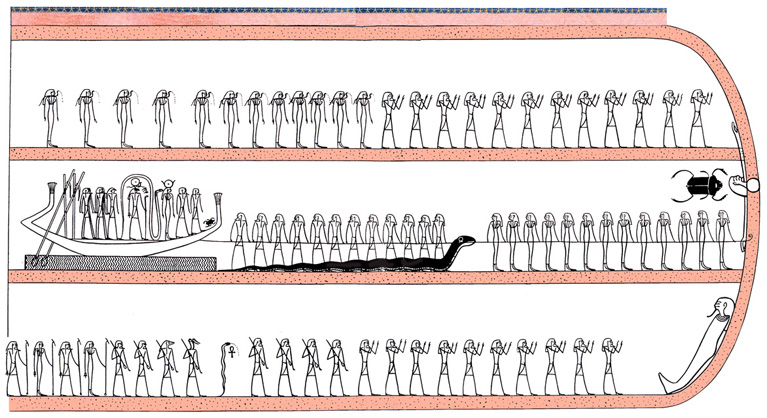
Drawing by A.G. Shedid (digitally
enhanced) -
Hornung (1999).
In this last hour, Re emerges out of the World-Encircler as Khepri and
the permanent renewal of Re out of himself is again visible to all.
In the lower register, we see four pairs of primeval deities (from precreation)
assisting in the act of emergence. The frame of the picture is broken, for these
deities come from a remote, preexisting realm, one supporting the process of
Solar renewal from "behind". At the end of this register, the mummy or "sah" of
Osiris called "the image of Osiris" remains in the
Duat. Re and Osiris separate, for Re enters the day-bark while Osiris is bound
to stay in the Duat.
The upper register begins with twelve goddesses wearing fire-spitting serpents,
followed by twelve gods who raise their arms in adoration of Re and his rebirth.
"They worship this great god at dawn, when he rests in the
eastern gateway of the sky. They say to Re : 'Born is he, who is born ! Who has
emerged, has emerged ! Venerated of the Earth, Ba-soul of the Lord of Heaven !
The sky belongs to your Ba-soul, that it may rest in it. The Earth belongs to
your corpse, Lord of Veneration ! You have seized the horizon, that You may rest
in your shrine, the two goddesses raise You with their body ! Acclamation to
You, Ba-soul which is in heaven ! Your two daughters receive You in your form.'"
Amduat, 12th Hour, 809 - 812.
In the middle register, the Uraeus reappears on Re's brow. He has gained full
power again. The new Sun is born out of the "World-encircler" carried in the
hour before. It is ready to receive the Solar barque, the gods and all the dead.
They enter the tail as "old ones" who are "weak
from age", travel through its spine, and come out at the mouth, fully
rejuvenated. An inversion of time occurs in the body of this snake, for
"the Ka-energy of him who makes the gods live" is
the "Life of the gods".
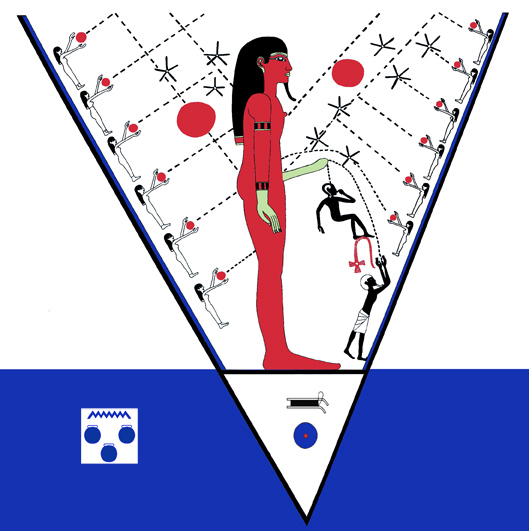
The 12 hours of
Time and Form emerging from singularity - drawing by
Rossini (1999).
In the upper register, ten gods raise their arms in adoration and say to Osiris
:
"Live, living one ! Foremost of his darkness ! Live, Great
one ! Foremost of his darkness. Lord of Life, Ruler of the West, Osiris,
Foremost of the Westerners. Live, living one ! Foremost of the Duat ! The breath
of Re belongs to your nose, the breathing of Khepri is with You, so that You
live and remain alive ! Hail to Osiris, Lord of Life !"
Amduat, 12th Hour, 843 - 845.
The Sungod is transformed into Khepri and lifted by the arms of Shu to the
eastern horizon.
Epilogue
: Death is the Hidden Chamber of Life.
"In Egypt, knowledge about the afterlife is not a secret
teaching and is not part of initiation, revelation, or of a mystery cult, as in
the later Greek tradition. It springs from a deep insight into the necessity for
continuous regeneration, blocking the aging process of all being. (...) This
really means a continuous reconnection of the day-world and the night-world, of
consciousness and the unconscious."
Hornung & Abt, 2003,
pp.144-145.
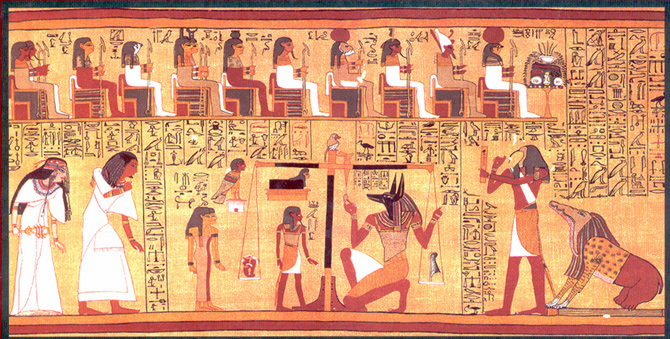
The Weighing of the Heart or
Judgment in the Afterlife
Papyrus of Ani, Plate 3 - ca. 1250 BCE - XIXth Dynasty - British Museum
Humans never stopped
developing icons & symbols about post mortem forms of sentience. Is
the set of non-material things empty ? Materialism affirms this at the price of
being unable to explain reason. Spiritualism negates, but excels when material &
non-material events are integrated (cf.
A Philosophy of the Mind and Its Brain, 2009).
Material & non-material occurrences are necessarily complementary and imply one another.
They work as interacting, interdependent operators or "'powers", as a limited
series of quasi-independent subprocesses generating order. Because of their
functional characterization, they are irreducible (cf.
Criticosynthesis, 2008).
Popper & Eccles (1981) favour an interactionist model, rejecting the monism
of materialism, only proposing particles and a set of forces. The First Person
Perspective is not epiphenomenal. A Cartesian dualism between matter (cf. "res
extensa") and mind (cf. "res cogitans") ensues. In view of recent
developments in science, a triadism seems more appropriate, in which hardware
(the physical executants), software (the non-physical code) & userware
(the non-physical sign-givers) are considered together (cf. Popper's
introduction of three worlds).
Consciousness posits meaning. Knowledge is the
integration of meaning in glyphs.
Information detains the intersubjective code,
the synthesis of all past meaningful processes, whereby problems were swiftly &
successfully solved.
Matter is the executant organization, its architectures and
momenta.
Considering how the afterlife is viewed in
the West, three vectors are prominent :
-
Ancient Egyptian tradition :
rooted in African Shamanism and its spirit-worship, for over four
millennia and longer, communication with the
afterlife was considered evident & ongoing.
Magic provided
the ways to enter the spirit world, had the tools to guarantee spirits work
(cf. the "false doors", talismanic magic, mummification, godforms, etc.)
and provided the paths to become a
"justified", a "blessed" or "noble" dead. In
funerary theology, the image of the balance was
fundamental. While
sapiental instructions gave the morals at hand, books
like the Amduat held the magical keys. By placing these texts near
their sarcophagus, these kings identified Re's night-boat with their own
death & forthcoming renewal. The text told them how to rise on the "barque
of millions", rejuvenated just before dawn. Here, death is the Hidden
Chamber of life itself, for the living benefit the dead and vice versa.
A continuous exchange between light & darkness, life & death, eternal
recurrence & everlastingness is displayed
;
-
Hellenism : Homer
spoke of the realm of the dead as a sinister place, where the dead wander
like ghosts. In Late Hellenism, when Egyptian, Middle-Eastern & Eastern
influences have been assimilated, the so-called "Elysian fields", the
final resting place of the heroic and the virtuous, are envisaged
(prefiguring the Christian heaven). Popular magic, interlinked with
astrology, existed and was widespread. Shamanistic practices (trance,
spirit-worship, sacrificial offerings, etc.) are intermixed with prayer &
rituals. Paganism formed a very exotic tapestry, with hells & heavens à
volonté ;
-
Abrahamic monotheisms
: in
Judaism,
Christianity &
Islam, the afterlife is a given, but communication with it
avoided and magical dealings with it condemned (not negated). In
Qabalah,
Christian mysticism &
Sufism, the afterlife is accepted but not discussed much. Since
the subjugation of Christian Gnosticism and its neo-Pagan overtones in the 2th century, Christianity
rejected reincarnation, while both the Qabalah and certain Sufi sects
allowed it. But a systematic study of dying & the afterlife lack.
Special rituals to prepare are absent or applied at the very end of life,
when death is imminent (like last rites in Catholicism).
|
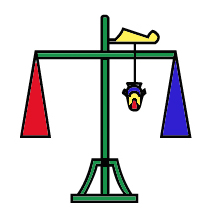
U38 "mxAt", balance, justice |
(Anubis checks the plummet and watches this small text-line) :
"Said he-who-is-in-the-tomb : 'Pay attention to the decision of
truth and the plummet of the balance, according to its stance.'"
Papyrus of Ani - XIXth Dynasty
Weighing Scene (cf. supra)
Chapter 30B - plate 3 |
In the Mediterranean
context, Egypt's view on afterlife was extraordinary. It was also very old
(at least ca. 3300 BCE), going back to African models linked with
Shamanism (ca. 7000 - 10.000 BCE). Egypt's funerary theology was
exceptionally developed, in particular that of
Osiris. Not only
could one properly prepare for death, but the voyage and its final
destinations are described with minute care. The dead are not dead ! As on
Earth, they exist "in the West", in the kingdom of Osiris or, in the case
of royals, in the boat of the Sungod. From the practice of "false doors"
(used by the Ka of the deceased to gratify the Ba with the received
offerings), to the complex mental constructions of the ante-rational,
magical mind (Pyramid Texts, Coffin Texts, Book of the
Dead, Amduat, Book of Gates, etc.), communication with
the spirit-world was ongoing. Royal ritual & popular belief were both
rooted in ancestral connections with the African spirit-world, of which
Egyptian religion is a sublime example. This spirit-oriented fundamental
ground was
fused with the conceptual restrictions of the "schools" :
Memphite,
Heliopolitan,
Hermopolitan,
Theban or
Osirian.
The Amduat repeats over and over
again how the living also benefit from its teachings. This point is
important and shows how these texts can and were adapted to various
contexts, in this case this-life regeneration rituals, associating
the Hidden Chamber with the night (and rituals) of sleep, dream & rejuvenation (cf.
dream temples, the darkness of the naos, the darkness of the
Osireon etc.) and afterlife
renewal rituals, associating the Hidden Chamber with rebirth as an "Akh of
Osiris" or on the barque
of Re, participating in the eternal recurrence of the Sungod's power, his
perfect control over the process of his own auto-regeneration.
This
renewal, at the heart of the transformation, comes about by entering the everlastingness of Nun, the
undifferentiated darkness with its luminous potential of autopoiesis. Re
enters by way of total darkness and isolation (4th Hour), secretly ignites his self-transformation, generating
burning water (5th Hour), completes his rekindling in the 6th Hour,
assuming the death posture.
Let us briefly approach this recurrent necessity of darkness from three perspectives :
neuroscience : is there a special effect of
darkness on the brain ?
depth-psychology :
understanding Re as an icon of consciousness, can the process of
individuation (Jung) be related to what happens in the Hidden Chamber ?
altered states of consciousness
:
how do various states of consciousness connect
with these Kemetic insights ?
Neuroscience
The recurrence of the role of darkness in
many spiritual practices is interesting and merits attention.
It may point to a universal neurotheological mechanism, i.e. a constellation of
neurological conditions pertaining to the execution or "computation" of
the spiritual function of consciousness in humanity as a whole. In his utopian novel Island,
Aldous Huxley used the term "neurotheology" for the first time. At
present, the discipline studies the
cognitive neuroscience of religious experience and
spirituality. Divorced from explicit theistic or deistic contexts, it
is synonymous with neurospirituality.
In the biochemistry of the brain, the neurotransmitter serotonin is
produced in reaction to light. It enables us to inhabit normal waking
consciousness and experience "reality" as it is nominally grasped. In
darkness, melatonin is produced instead. It is converted into pinoline,
which is involved in dreaming and new states of consciousness, allowing us
to see "reality" in different, extra-nominal ways. Once pinoline is released,
the production of the biochemical DMT (Dimethyltryptamine) is stimulated.
DMT is the brain's ability to generate the reality of our
imagination. It is naturally produced in small quantities in the human
brain, possibly in the pineal gland. Interestingly, DMT is also one of the main active
ingredients within many psychotropic plants,
causing intense, magificient visions & hallucinations, making users
enter an altered "environment".
These findings are in tune with Shamanism and its psychophysiological dynamics of altered states of consciousness,
visionary experiences, metaphoric representations & rituals triggering healing responses,
causing regeneration & rejuvenation. The shaman is able to induce
trance-states at will, often assisted by hallucinogenic
substances.
"One thing that comes out in the myths is
that at the bottom of the abyss comes the voice of salvation. The black
moment is the moment when the real message of transformation is going to
come. At the darkest moment comes the light."
Campbell, J. : The
Power of Myth, 1988.
Entering "darkness" implies breaking
away from so-called "nominal", "normal" life, with
socially-prescribed conditionings of the world
outside. This corresponds with "the entry", the first stage
of the Upper Paleolithic cave mysteries :
-
"the entry" : First
Phase : the tunnel
into the mountain :
the process of differentiation from light to darkness ;
-
"the sanctum" :
Second Phase : the
rock cathedral in which the shamans dance : the secluded place of the mystery of the hidden light.
Here, a simile of light is experienced and the play of shadows is
fundamental in conveying an abiding sense of a renewing reality, beyond
darkness & light ;
-
"the return or exit" :
Third Phase : returning to the outside transformed : the process of integration
from darkness to light, culminating in manifestation or appearance.
The use of ceremonial darkness is a traditional and universal method for
accessing invisible landscapes and embracing the deeper aspects of our
unconscious, conscious & supra-conscious states.
Levels of
Consciousness |
Modes of
Cognition |
Type of
Concept |
Type of
Sign |
Type of
Cortex |
UNCONSCIOUS
MYTHICAL |
mythical |
notion |
signal |
reptilian |
CONSCIOUS
ANTE-RATIONAL |
pre-rational |
pre-concept |
icon |
mammalian |
|
proto-rational |
concrete concept |
CONSCIOUS
RATIONAL |
formal |
abstract concept |
symbol |
human |
|
transcendental |
meta-concept |
SUPRA-CONSCIOUS
INTUITIONAL
META-RATIONAL |
creative |
limit-concept |
|
nondual |
concept-of-no-concept |
signless |
Being in continuous and complete
darkness over several days brings about stillness of the mind and, from
this quietude, our innate powers of intuition and creativity are released
(cf. the Dark Retreat in Dzogchen).
The gifts of darkness include the experience of unusual phenomena, such as
lucid levels of consciousness, where the borders between dreaming and
not-dreaming diminish and disappear. The effects of
prolonged periods of darkness are unique for each person, but also rather
consistent, including the renewal of one's energy (rejuvenation), the
ability to move past self-limitations (transformation), to meet life's
challenges with greater ease (resurrection), and increased fearlessness.
At death, this darkness will have to be faced, and preparing for this may
even prolong life.
Apparently, all these features are present in the description of the
Hidden Chamber.
Neuroscientist
MacLean (1970,
1978, 1990) advanced the concept of the triune
brain. In the brain as a whole, he identified a three-tiered structure, called
"reptilian", "mammalian" and "neocortical". This
division has been used by neurotheologians to explore the meeting between
religion and neuroscience (Albright & Ashbrook, 2001). MacLean and other
researchers have observed animals whose activities depend on each of these
"brains". In this way, various functions have been attributed to each
of these three parts of the brain, characterized by a different structure and
chemistry, yet extensively interconnected.
-
the
reptilian brain : brain stem (midbrain, pons, medulla), midbrain,
hypothalamus ;
-
the
mammalian brain : thalamus, hippocampus, amygdala ;
-
the
human brain : neocortex of cerebral hemispheres of cerebrum, angular
gyrus.
Compare this with the anatomical
division of the brain in fore-, mid-, and hindbrain :
Reptilian brain :
hindbrain
+ midbrain + hypothalamus ("oldest" master controller)
;
Mammalian brain : higher
thalamic diencephalon + basal telencephalon (hippocampus and amygdala, the "old" senior
executive) + cingulate
cortex (relay to cortex)
;
Human brain : forebrain,
neocortex ("new" senior executive, in particular the prefrontal
cortex).
In darkness, the visual cortex is "cut off" or
deafferented and
the limbic system of the mammalian brain & the reptilian brain
may "take over". As conceptual symbols are processed in the prefrontal lobe of the
neocortex, conceptual, symbolic thought is reduced, while signals (stand-alone,
percussive stimuli conveying imminent meaning) & iconical
representations (images charged with emotions) emerge.
In fact, in the First Phase of the process, a cognitive regression happens :
ante-rational layers are again "in charge", while the discursive processing of
information is slowly stopped (cf. the reduction of Re's ability to communicate). The
cave is entered and everything darkens. The eyes adapt, trying to sense a diminishing
number of photons. This continues until thick darkness surrounds one for a long
time. Then, at the deepest point, strange sounds are heard & visions are seen,
offering data to be interpreted by the neocortex, now computing on the basis of
"inner experience". This is the Second Phase, hearing the howls & cries of the
shaman and his choir, entering the shadow-lit rock cathedral. The limbic system
urgently feeds new, strange data to the neocortex, in vain trying to find
previous patterns to deal with the information. The "sacrament" of the "Cavern
of Sokar" is amply addressed in the text. It is mysterious, secret and crucial
in securely igniting the "athanor" rekindling Re. After the transformation has
happened, the initiate leaves by another way, empowered by the addition of a new
sense of reality, triggered by experiencing these powerful events. Too much
enthusiasm is often lethal (cf. Apopis in the 7th Hour). One must carefully
recollect and with peace of mind return to the nominal level of experience. This
is the Third Phase, leaving the rock cathedral and finding a way out to convey
the experience to others, either in deeds or words or both.
Depth-psychology
"There can be no transformation of darkness
into light and of apathy into movement without emotion." -
Jung, C.G : The
Undiscovered Self, 1957.
The Sungod represents a healthy, complete,
integrated, enlightened consciousness. "Old" but still vigorous when
entering the Duat, on his netherworldly journey he continues blessing its
citizens, providing them. He exits renewed and (as we learn at the end)
was constantly protected so nothing could fail ! He knows the names and the
gates and his whereabouts in the Duat. The Amduat depicts the healthy,
completed ante-rational mind, open and aware of the interdependence
between all complementarities and enjoying a "closure" in terms of a
practical iconography of regeneration.
Carl
Gustav Jung (1875 - 1961), a colleague of Freud, initiated so-called
"Analytical Psychology", another view on depth-psychology
besides Freudian psychoanalysis. Jung developed a depth-psychological
model of man, which invited a psychological comprehension of symbols,
myths, rituals, dreams and spiritual practices, irrespective of their
spatial (place) and temporal settings. In his studies on psychology &
alchemy, he integrated the concept of the "Sol niger" or "black
Sun" of alchemy, emiting "dark light" (Collected
Works, vol.12, § 140). At midnight, this black, dark Sun shines as if
were noon (cf. Apuleius : The Golden Ass, second century CE).
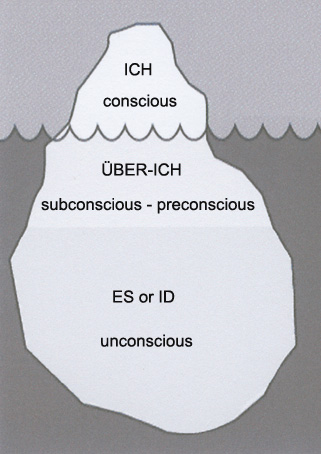
Freud's
model of
the psyche
For Jung, Freud's conception of the unconscious (the libidinal drive,
rooted in "Thanatos & Eros", was deemed too personalized and limited to a
certain era).
Originally, the concept of the "unconscious" was limited to denote the
state of repressed or forgotten contents. Freud made the next step ;
the unconscious (as a storehouse of repressed psychic material)
operates as an acting subject within the subject. The unconscious
is the origin of an intra-psychic conflict. Freud, although aware of the archaic
&
mythological foundation of thought, affects & volition, approached the unconscious from
his own
personal perspective.
Jung conjectured the "personal unconscious" rested
upon a deeper, inborn layer, with contents and modes of behavior
"that
are more or less the same everywhere and in all individuals. It is, in
other words, identical in all men and thus constitutes a common psychic
substrate of a suprapersonal nature which is present in every one of
us." (Jung, Collected
Works, vol.9, 1, § 3). The "collective unconscious" contents
are archaic, primordial types, or "archetypes" (a term also used
by Philo of Alexandria with reference to the God-image in man). Jung
pointed out that in all spiritual traditions, folklores, myths and
fairytales of humanity, esoteric teachings are contents of the
collective unconscious which have been perceived and changed into
conscious formulae. Archetypal ideas are the manifest, visible form of
archetypes. An archetypal idea is "essentially
an unconscious content that is altered by becoming conscious and by being
perceived, and it takes its colour from the individual consciousness in
which it happens to appear." (§ 6). What an archetype as such is, can thus never be known.
The model of Jung may be partly in accord with the triune brain
:
-
the
human brain (a neocortex divided in two asymmetrical hemispheres)
processing ego-consciousness, subconscious, personal unconscious &
Shadow ;
-
the
mammalian brain (limbic system) executing the archetypes of relatedness
of the collective unconscious : the Anima or the Animus ;
-
the
reptilian brain (brainstem) computing the archetypes of transcendence
(cf. the "fourth" state) of the collective unconscious : the
Self.
Let us focus on the basics of
Jung's archetypal psychology, namely the process of "healing the soul" or
"individuation", the complete development of the psyche and the emergence
of the "total man". Jung conjectured this process of
individuation entailed the conscious integration of three fundamental
archetypes.
Paraphrasing him, we may say the integration of the "Shadow" comes first,
followed by the assimilation of the "Anima" (or "Animus"), topped by the
experience of the "Self".
Temple
Ritual
(Edfu, Dendera) |
Qabalah
(Tree of Life) |
Christian
mysticism |
Alchemy |
Jung |
| courtyard |
KA |
Assiah |
probatio |
negrido |
Shadow |
|
pronaos
hypostyle hall |
AB |
Yetzirah |
purificatio |
offering
hall
ambulatory |
BA |
Briah |
illuminatio |
albedo |
Anima
Animus |
|
naos |
AKH |
Atziluth |
Deificatio |
rubedo |
Self |
The Shadow personifies everything a person refuses to acknowledge
about himself, leading to complexes and compulsive, obsessive activities.
In a male (female), the Anima (Animus) is the unconscious feminine
(masculine) side. This polarity (duality) has to be assimilated by
perceiving the archetypal ideas which emerge because of both.
Only when the latter has happened, may the Self emerge as the point in the
middle of the circle. This is the total man, the "supraordinate
personality", the individual as s/he really is and not as s/he appears.
Because a person's ego is related to the Self as a part is to the whole,
the Self is called "supraordinate". To this wholeness, the
collective unconscious also belongs. Jung interpreted the collective
unconscious as "impersonal" (§ 314), and so the Self was unable
to arise in consciousness directly, but manifested exclusively by way of
projection. Jung was not a hylic pluralist.
In a Jungian approach,
the Egyptian deities are archetypal ideas. Hence, Egyptian religion as a
whole is looked at as the manifestation of various systems of archetypal
ideas (cf. the Enneads or "companies of gods"). Myths and
theological systems reveal psychic phenomena, i.e. collective &
subjective (Ancient Egyptian) perceptions of objective natural events,
rather than observation of facts.
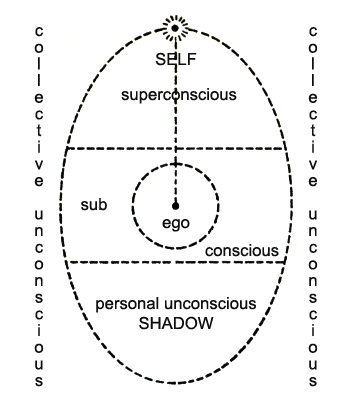
Alternative model of
the psyche
developed by Roberto Assagioli This is especially so for the psyche at work in the Amduat, as Re
eternally reborn by nightly returning to the first instance of the hidden,
fugal & precreational Atum.
Ars obscura
"Lead us up beyond
unknowing and light,
up to the farthest, highest peak
of mystic scripture,
where the mysteries of God's Word
lie simple, absolute and unchangeable
in the brilliant darkness of a hidden silence.
Amid the deepest shadow
they pour overwhelming light
on what is most manifest.
Amid the wholly unsensed and unseen
they completely fill our sightless minds
with treasures beyond all beauty."
ps.Dionysius the
Areopagite : The Mystical Theology, introductory poem.
In waking, dreaming, sleep & spiritual
practice, "darkness" also intervenes. While dreaming & sleep invite
darkness to operate, waking hours are filled with short moments of
oblivion, with blinking & daydreaming. Observing carefully, we see how between thoughts
"gaps" can be identified. These "intervals" between two subsequent moments
of sentient attention & wakefulness are the "dark" blind spots of
awareness, while eventually "in" these gaps the natural light of mind can
be discovered.
Since the Upper Palaeolithic (ca. 40.000 - 10.000 BCE), darkness has been a universal constant
in spiritual practice, and its use a
secret. In all spiritual cultures, darkness led towards the light. In this
practice of the Earth, or Shamanistic approach, Solar and Lunar currents
are in unisono, i.e. in constant interaction within the consciousness of
the Shaman. His cognitive mode was ante-rational and no constant,
context-independent symbols were at work. Signals & icons prevailed, while
the secret names of the superpowers deemed to control Nature were
whispered.
In Pharaonic magic, the use of darkness prevailed, playing the "scenic"
role of Nun and Osiris (while Akhenaten eliminated the roofs !). The
"Shaman" became a "priest of Osiris", able to fulfil immediate needs and
in touch with darkness. The Osireon was such a special place. Probably it
was erected for the priesthood. "Seeing" the dark
light after having been (in procession) through the long, dark tunnel
giving access to the corridor of the hidden chamber, where, as in the
Osireon, the ornate mummy of Osiris lay, was like being touched by the
revitalizing light of the dark Sun, regenerating the power of Osiris by
the Eye "that sees him", enabling Osiris to bless the living & the dead
...
"The Sun is extinguished in old age,
but rekindled again."
Heracleitus :
Fragments, XLVIIIB (in Plato's Republic).
The "Art of Darkness" revealed in the Amduat consists of
harmonizing all opposites by interconnecting them as complementary,
integrating life & death, light & darkness, Re & Osiris. In this process
of regeneration, consciousness is refreshed, enthusiasm & vehemence are
renewed and another cycle begun.
In many indigenous traditions around the globe, darkness is invoked and
integrated. The Shamanistic approach differs from the Greek take,
designating goodness to light and loss (of family, memory, life, name) to
evil. Co-relatively, the Greeks considered the mysteries and the
philosophy behind spiritual initiation in terms of a movement away from
the physical body. They deemed it unfit for anything "of the higher".
Neither, so they thought, does its death bring anything luminous. Tricked
into loosing their memories, the spectres of the dead wander aimlessly for
ever in the dark, desolate and moaning.
In Ancient Egyptian initiation, the physical body was the gate to the Duat
(hence the importance of divine "words of power" and rituals). Using
Shamanistic tools (like various preparations & purifications, special
words, closed spaces, incense & herbs, increasing darkness, music,
chanting, astronomical timing, spatial semantics, etc.) or by the use of
complete darkness, the priests went into collective trance-states and
operated rituals therein.
The Greek mysteries, as well as the standard slowly rising among the
intellectuals of the Greco-Roman world, both involved a formal, "Hellenic"
theoretical training, as can be seen in the educational institutions of
Alexandria. In Paganism, light and its philosophy were outstanding, while
the Solar and Lunar crystalized in separate cults. Isis, Osiris & Horus
were part of the exoteric standard. When Rome became Catholic, this would
change for ever, and the emperial system became the Papacy. A more Solar
institution cannot be found on Earth.
The Greek dichotomy between light/spirit (good) & darkness/body (evil)
entered Judaism. While originally the "YHVH ALHYM" was origin of goodness
& evil alike, He slowly turned to goodness only. The influence of Greek
thought on this development is unmistaken. As soon as light & dark are
disconnected, Solar & Lunar spiritualities first separate and then move
their own ways. This causes spiritual traditions to cease. In the case of
Judaism, a "Solar" return to the "origins" can be observed (cf. the Dead
Sea communities). This to counter the vast, irreversible influence of
Hellenism. With the destruction of the Second Temple, an irreversible new
phase was entered, and Divine Presence (or "shekinah") became more
mystical & diasporic. In the Christian West, Almighty God the Father was
deemed exclusively good and His messengers beings of light. He utterly
dislikes evil, does not create it, but tolerates it for the sake of free
will.
In Islam, Allah wills good & evil, but prescribes goodness for human
beings. Creation is a mixture of good & evil, and Allah is only good. When
people follow His prescriptions, He protects them and they are happy.
Although "Arabesque logic" has a paraconsistent streak enabling the secret
integration of the Lunar current, its exoteric outlook, developed in
communication with Greek thought, is truly Solar. Light is a name of
Allah. Darkness not.
In the Greek tradition, the myth of Icarus is important. More than one
Greek philosopher warns for "hubris", outstepping one's own limitations,
resulting in one being overbearingly presumptuous. Especially in tempting
the Gods ! Icarus wanted to see the Sungod and His course close-by. But
moving too far into His light caused his demise. He drowns. Apparently,
too much Solar power cannot work. The Apollinic spirit is powerless "on
its own". Every good play needs more than Solar (mental) words, but also a
chorus and music, both emotional and Lunar. So in this tale, the Dionysian
current is at work. The Lunar Dionysian cult provided the essential
balance, compensating for the largely Solar "academic" Paganism. It
represented the "dark", bestial capacities of the Gods. For the
Christians, Pan (like Seth) became an epitome for the devil. The terranean
and subterranean Deities were dethroned in the Name of Jesus Christ, the
New Sun, the emperor of the cosmos.
"... the life
which philosophers desire is truly death ..."
Plato :
Phaedo, 63.9
Icarus shows the more one reaches for the light, the larger the shadow.
This is the danger of turning away from darkness and the Earth, away from
the physical & the emotional, towards a mental, symbolical reification,
the hypostasis of a Self, an ego, a personhood, etc. Like differentiating
by spreading photons. Turning towards the light without facing darkness
and giving it a positive, constructive spiritual meaning. Turning towards
outer manifestation without inner dissolution. Towards form without
formless, etc. these cause the affirmation of a "real" subjective "I"
existing from its own side, without the others. Without facing darkness,
the shadow cannot be seen and so cannot be integrated. Eventually, the "I"
collapses under its own hallucinations & delusions.
The Osirian priests of Ancient Egypts, prophets of Judaism, the mystics of
Christ & the prophet of Islam have all experienced the hidden, dark light
"seen" in total darkness. Christian mystics like John of the Cross speak
of the "dark night of the soul", in which the depth of one's existential
misery is faced and overwon. If not, insania amoris or primal rage
ensue. In the dark, the need to cling to a sense of ego, Self or
personhood is lost. The dark constitutes the "container" (cf. the Cave of
Sokar or "black box") in which the regeneration occurs. Total tranquility
in total darkness. In the total embrace of the dark, this absence of
photons becomes an archetypal encounter, and so luminous. This is a
"brilliant darkness", as ps.-Dionysius puts it.
To see this mysterious dark light, consider the fundamental function of
the black box : to discover everlasting, undifferentiated, unbounded
wholeness beyond form & formlessness. Then the natural order is exited,
and the sea of dark light regenerates in thick darkness. This ignites the
transformation, completed within the five-headed serpent "Tail-in-Mouth",
"the mysterious image of the Duat, unknown and unseen".
In the Qûmran scrolls, the writings of an
ultra-orthodox, revolutionary Jewish sect shunning the centralized
religious authorities (the Sanhedrin backed by the Romans), the battle
between light (goodness) & evil (darkness) is imminent.
"But Thou, O God,
dost despise all Satan's designs ;
it is Thy purpose that shall be done
and the design of Thy heart
that shall be established for ever."
Thanksgiving Hymns, 1QH, 7
- translated by Vermes, 1990.
In a Manichean style, both domain are radically opposed and no integration
between them is possible. Humanity finds itself in the midst of a cosmic
battle between angels & demons, and only thanks to the Messiahs will it be
able to properly choose and say thanks for God's goodness.
"And when they shall gather for the common table, to eat and to drink new
wine, when the common table shall be set for eating and new wine poured for
drinking, let no man extend his hand over the first-fruits of bread and wine
before the Priest ; for it is he who shall bless the first-fruits of bread and
wine, and shall be the first to extend his hand over the bread. Thereafter, the
Messiah of Israel shall extend his hand over the bread, and all the congregation
of the Community shall utter a blessing, each man in the order of his
dignity."
The Messianic Rule (1QSa) -
translated by Vermes, 1990.
Likewise, Greek Platonism introduced a radical "chorismos" or
separation between the world of becoming (a world of shadows) and the
world of ideas (a world of light). Becoming is given a lower ontological &
moral value. Plotinus will cast this in his famous "privatio"-formula,
according to which evil is absence of good. These ideas will enter
Christian theology, and animate soteriology & eschatology. These Greek
thoughts on evil will also influence Islam philosophy, identifying "evil"
as absence of "good".
"In a system such as that of Plotinus, the
status of the principle of evil is unclear. On the one hand it is the
lowest order of being or lacks being altogether. Ontologically it scarcely
exists. But when the moral element is introduced, it is possible to
conceive of a being of high ontological status making a choice for evil.
This idea, although an implicit possibility in Plotinus, was never an
explicit option for him, but it eventually became part of Christian
tradition."
Russell, J.B. : The Devil, Cornell University
Press - London, 1977, p.166.
In terms of salvation, darkness and diabolism are identified. When
accepting Christ as one's personal Savior, the works of Satan, the
opposer, have to be openly rejected. Only by eliminating darkness can one expect
light to enter. One has to "open up", so the dark spaces may be
removed by the rays (cf. "metanoia"). A turn of heart is a move away from the
"prince of this world" and by accepting what Christ did on the Cross, we
are liberated (cf. baptismal vows). The Passion is precisely Christ's
victory over the forces of darkness and evil. He broke the chains with
which Satan enslaved humanity.
Also at the "end of time", Satan is not recuperated or integrated. There
is no "final restoration" or "apokatastasis" (Clemens of Alexandria,
Origin), and the Devil is for all of eternity separated from God, locked
away in his hells. Creation "ends" with an absolute division, and God
cannot reunify what was, at the start, a fundamental unity. Why ? Because
Satan does not really exist, but is an amalgam of shadows (a legion, not a
unity). Hence, given Platonic ontology, one cannot conceive how good &
evil could be reconciled at the End of Time. On this last day, God and the
blessed abide in heaven and Satan and the damned in hell. This division is
absolute, lasting and irreversible. In some way, Origin is right, for this
obviously conflicts with the fundamental unity of the Divine, and also with God's
compassion & omnipotence. The mysterium inequitatis ?
In the Judeo-Christian tradition, this situation had sad results. Once a
part of being is rejected, it can be projected on anything one dislikes.
As a result, devils abound ! The more the division is stressed, the more
Satan is "out of control". Such a Satan is able to invent his own religion
(Satanism) and establish himself as an alternative to God. In
Christianity, his role becomes grotesque and absurd, acting as an excuse for
every evil deed humanity can think of. His importance brings down God's
omnipotence and questions the active power of goodness, of Christ, to
really redeem this world ... In Islam, Iblis prays and makes a deal with
Allah. Far from being a creature able to turn against God's will, his
intentions are not cosmic but anthropological : he wants to tempt
humanity, for he does not wish to bow down before this creation God made
out of clay. Here the Devil returns to the role he had in the Book of
Job, that of accuser. He tempts man to point to his misdeeds,
confirming his weakness and, despite being God's "special" being, low
status.
Christian
theodicy is rather inconsistent. If God is exclusively good (as "privatio
boni" entails), then the presence of evil cannot be said to be caused
by God. Although we can accept a good God who tolerates evil to respect
human free will, the atrocities of history cannot be explained in this
way, nor can the destruction of the innocent.
Indeed, French existentialists, such as Sartre, saw the
existence of the Christian God refuted by the crashing presence, since the start
of human civilization, of evil in the world. The morbid dictators of modern
times confirm the
activity of evil despite two hundred years of radical political, economical and
technological innovations.
If God is good, then a priori evil does not exist,
but evil is a historical fact, ergo, the good God does not
exist.
Ancient Egyptian theodicy does not face these problems. The divine
embraces good and evil alike. One could say the gods will both good &
evil, but bind man to the good. Two levels of evil are identified : on the
one hand, evil is part of creation and a force opposing light. Eventually,
and this endlessly so, this catabolic evil is subdued by the anabolic
order of light (Seth assists Re). On the other hand, evil is part of
precreation and a force opposing the order of creation as a whole
(Apopis). This evil inimical to life itself is subdued by the controlled
"evil side" of creation (i.e. Seth) !
So in all cases, evil has its own ontological status, either as focused
destructiveness, i.e. Seth, complementing focused constructiveness, or as
a random chaos of sorts (cf. Apopis). Evil is never "cut off", on the
contrary, it is subdued by life (Re & the gods make Seth carry Osiris,
Seth helps the Ba of Re) or is controlled
by these selfsame life-serving destructive forces (Apopis is ruled by the
Eldest Magician). In no case is evil annihilated, negated, isolated or
deprived of interdependent connections with life and creation (as "privatio"
dictates). As in
chaos theory, Seth operates like a "hidden attractor", allowing for a
higher type of order to emerge (Re-Atum), while Apopis is like the
absolute chaos of absolute entropy, eliminating all possible
differentiation, as in the total darkness of Nun, flowing deep underneath
the kingdom of darkness & dead of Osiris.
Just like Seth is the catabolic part of a creation based on anabolic
processes of light (Atum-Re), the darkness of the Duat of Osiris crossed
by Re in his night-bark complements the luminosity of Re crossing the sky
in his day-bark. Just like Seth is called to stop Apopis, so, in thick
darkness, the Midnight Mystery allows Re to return to the first instance
of creation and regenerate. Darkness is invoked to bring new light and new
light eventually returns to darkness. This cycle is without end and
fundamental to understand life, creation and the recurrent cycle of
arising, abiding, ceasing and rebirth.
|